
Dog Noise Complaint Singapore: 7 Steps to Take
A dog noise complaint in Singapore usually starts with a calm conversation with the owner. If the barking continues, contact the relevant Town Council or HDB channel, and submit animal-related feedback to the Animal & Veterinary Service (AVS). AVS is the lead agency for animal matters, while HDB can advise owners about pet-related disamenities.
Barking can disrupt sleep, work and family life, particularly in a high-density HDB block. However, a formal complaint often works better when you provide clear, objective information rather than only describing the noise as “constant”. This guide explains:
- how to raise the concern without escalating conflict;
- whether HDB, your Town Council or AVS is the appropriate contact; and
- what to record, submit and expect after reporting it.
Quick Answer: Where to Make a Dog Noise Complaint Singapore
The best starting point depends on where the dog lives and what the complaint involves. Speak to the neighbour politely when it feels safe. If the issue continues, use the relevant estate-management channel and send animal-related feedback to AVS through its online form or Animal Response Centre.
AVS operates a 24-hour Animal Response Centre on 1800 476 1600 for enquiries and feedback about animal-related matters. It also accepts feedback through an online form (Animal & Veterinary Service, source year not stated in the supplied material).
For an HDB flat, HDB guidance says owners should prevent their pets from causing nuisance, including barking. HDB may advise the owner to reduce the nuisance and may refer residents to AVS-accredited dog trainers when disruptive behaviour continues (Housing & Development Board; Ministry of National Development, source years not stated in the supplied material).
Step 1: Speak to Your Neighbour Before Escalating
A calm, specific conversation gives the owner a chance to identify the problem and act on it. In practice, the owner may not realise how clearly the barking travels through the corridor, ceiling or adjoining walls.
Choose a neutral time rather than approaching during a heated episode. Explain the effect on your household, then share dates and times instead of making personal accusations. For example, say that barking woke you at a particular hour, rather than saying the owner is careless.
What to note before the conversation
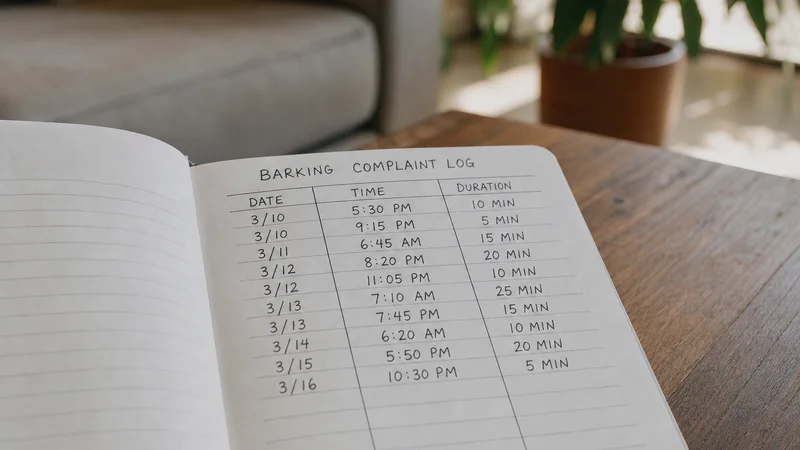
Keep a simple log for several days. Record:
- the date and approximate start and end time;
- whether the barking was continuous or came in bursts;
- the location from which you heard it;
- what happened immediately beforehand, if you know; and
- how the noise affected sleep, work or other essential activities.
This record helps the owner look for triggers, such as isolation, visitors or activity outside the flat. SOSD recommends identifying the reason behind a neighbour’s complaint and addressing possible behavioural issues (Save Our Street Dogs, source year not stated in the supplied material).

Keep the conversation safe
Do not enter the neighbour’s flat or confront anyone aggressively. If direct contact feels unsafe, use a brief written message or proceed through the appropriate official channel. Keep copies of messages and avoid posting accusations about the owner or dog online.


Pet Health Map App
Turn every worry into your pet’s health record
Download the app to save AI Care reports, build your pet’s medical profile, and keep tracking symptoms and care notes.
Android version coming soon. The web version is available now.
Step 2: Choose HDB, Town Council or AVS
The right contact depends on the nature of the problem. HDB is relevant to pet-related disamenities in HDB homes, your Town Council manages estate facilities and channels, and AVS accepts animal-related feedback.
HDB and Town Council channels
HDB’s pet guidance says owners must keep dogs and cats safely within the flat, prevent them from roaming and care for them so they do not cause a nuisance such as barking (Housing & Development Board, source year not stated in the supplied material).
Therefore, an HDB resident can raise the matter through the relevant estate-management route. Check your Town Council’s current contact channel before submitting details, because the correct office can depend on the block and estate.
AVS animal-related feedback
AVS provides a 24-hour helpline at 1800 476 1600 and an online feedback form for animal-related matters. Use these channels when the complaint concerns the dog’s welfare, ownership, licensing or behaviour beyond an estate-management issue.
| Situation | Practical channel |
|---|---|
| Barking linked to an HDB flat | HDB or the relevant Town Council channel |
| Animal-related concern or feedback | AVS helpline or online feedback form |
| Possible behavioural problem | HDB may refer residents to AVS-accredited trainers |
| Immediate personal danger | Contact the appropriate emergency service |
Give the same factual timeline to each agency. Avoid sending multiple emotional versions of the complaint, because inconsistent details can make the issue harder to assess.
Why Licensing Matters When a Complaint Is Filed
Licensing does not automatically resolve barking, but accurate ownership information can help an agency identify the dog and communicate with the responsible person. SOSD advises confirming that the dog is properly licensed when a complaint is raised.
The same guidance notes that unlicensed pets in HDB flats have been reported to face fines. However, the supplied source does not confirm the current fine amount. Do not rely on an old figure from a social media post or forum. Instead, verify the current position directly with AVS or HDB.
Check the licence through the correct process
Prepare the information you know, such as the flat address, dog description and owner contact details. Do not attempt to obtain private information through confrontation.
For the current licensing process and fees, use the PALS licensing guide:
Dog and cat licensing in Singapore: PALS guide
You can also review the rules that may apply to the number of dogs kept in an HDB flat:
How many dogs can you keep in an HDB flat?
Licensing evidence should support a complaint, not become a reason to harass the owner. Keep the focus on the barking, safety and the practical steps needed to reduce the nuisance.
Documenting a Barking Complaint Properly
A useful complaint shows a repeated pattern, not just one frustrating incident. A short, dated log gives HDB, the Town Council or AVS something concrete to review.
Use the “BARK” record
Use this four-part memory hook for every entry:
- B — Begin and end: record the approximate time and duration.
- A — Area: note where you heard the barking.
- R — Repetition: record how often it occurred that day.
- K — Known trigger: note anything observable, without guessing.
For example, “barking heard from adjoining unit, 6.40 pm to 7.05 pm, repeated bursts, visitors arriving in corridor” is more useful than “dog barked all evening”.
Preserve evidence responsibly
Keep recordings short and relevant. Do not trespass, film inside another person’s home or provoke the dog to produce noise. Written records, messages and lawful audio evidence may help explain the pattern.
Submit the information through the AVS feedback form or the relevant Town Council channel. Include your contact details if you want the agency to clarify the report, but ask how it will handle your information.
When Training or Mediation Can Help
Behavioural support can address the cause of barking, while mediation can reduce conflict between neighbours. The strongest outcome often combines both approaches instead of treating the complaint as purely punitive.
MND states that HDB may refer residents to AVS-accredited dog trainers when a dog shows disruptive behaviours. That option may help owners understand triggers and introduce practical changes, such as structured exercise, calmer departures or gradual desensitisation. The specific training plan should come from a qualified professional who assesses the dog.
Consider community mediation
If communication has broken down, a Community Mediation Centre may offer another route for resolving a neighbour dispute. Confirm the current service details directly before relying on this option, as the supplied sources do not set out its eligibility rules or procedure.
Meanwhile, avoid shouting through walls, banging on doors or retaliating with noise. Those actions can intensify the dispute and make an otherwise solvable problem harder to manage.
If you are the dog owner, respond constructively. Ask what times the neighbour notices the barking, keep your own behaviour log and seek professional help if the pattern continues.
What Happens After You Report
Reporting creates a record, but it does not guarantee an immediate removal of the dog or a fine. The available Singapore guidance points towards advice, nuisance-reduction measures and possible behavioural referral.
MND states that HDB will advise a pet owner to take necessary measures when a pet causes disamenities to neighbours. It may also refer residents to AVS-accredited dog trainers where disruptive behaviour is involved (Ministry of National Development, source year not stated in the supplied material).
Prepare for follow-up
After submitting a report:
- save the reference number or confirmation message;
- continue the barking log;
- respond promptly if the agency requests clarification; and
- report continuing incidents with dates rather than repeating general allegations.
Do not assume that one report proves a legal offence. The supplied sources do not establish a specific offence or automatic penalty for barking alone. If the dog threatens, bites or attacks someone, use the dedicated reporting route instead:
Report animal cruelty in Singapore: AVS and SPCA routes
For access to dog runs and public spaces, check the applicable guidance here:
Taking your dog to Singapore parks: NParks rules and dog runs
Conclusion: Make the Complaint Factual and Proportionate
A dog noise complaint in Singapore is most effective when it gives the owner and the relevant agency a clear pattern to address. Start with a calm conversation if it feels safe, then record dates, durations and effects. For an HDB flat, use HDB or Town Council channels, while AVS handles animal-related feedback through its helpline and online form.
Do not guess current fines or assume that barking alone guarantees enforcement action. Instead, verify licensing details with AVS or HDB and ask about behavioural support where appropriate. If the noise continues, submit your BARK log and keep every follow-up factual. This approach protects your household while giving the owner a fair opportunity to correct the problem.