
Guide Dog Public Access Law Singapore: A Practical Guide
If you rely on a guide or assistance dog in Singapore, access rights depend on the setting and the rule that applies there. Confirmed protection covers guide dogs on public buses when leashed and controlled. From 1 November 2026, updated SFA guidance may also allow assistance dogs in licensed retail food establishments.
A refusal can feel confusing, particularly when staff use “guide dog” and “assistance dog” interchangeably. However, transport rules and food-safety guidance do not operate in the same way. The practical questions are:
- What does the relevant Singapore rule actually cover?
- Does it apply to buses, taxis, the MRT, restaurants or housing?
- What should you record and do if someone refuses access?
This guide separates confirmed rights from areas where you should check the operator or venue directly.
The short answer: guide dog public access law Singapore
The clearest confirmed public-access rule concerns public buses. Singapore’s Road Traffic rules permit an individual to bring a guide dog into an omnibus, provided the dog stays on a leash and under proper control while that individual remains in the vehicle. The rule supplied here does not establish an equivalent right for every transport mode or venue.
From 1 November 2026, Singapore Food Agency guidance states that licensed retail food establishments may permit assistance dogs accompanying people with physical, visual or hearing impairments to enter. “May permit” matters: this wording describes updated food-retail guidance, not a blanket statement that every venue must admit every dog.
Therefore, treat access as a setting-by-setting question. Carry practical evidence of the dog’s working role, keep the dog controlled, and ask the venue or operator to identify the rule behind any refusal.
The important distinction
A guide dog usually supports a person with a visual impairment. An assistance dog can support a person with another physical, visual or hearing impairment. However, do not assume that a general label automatically creates the same legal entitlement in every location.
What the confirmed sources do not prove
The available sources do not confirm a universal access right for taxis, the MRT, workplaces, private housing or every public venue. Avoid relying on online claims that merge different rules. Instead, ask the relevant operator for its current policy before travelling.
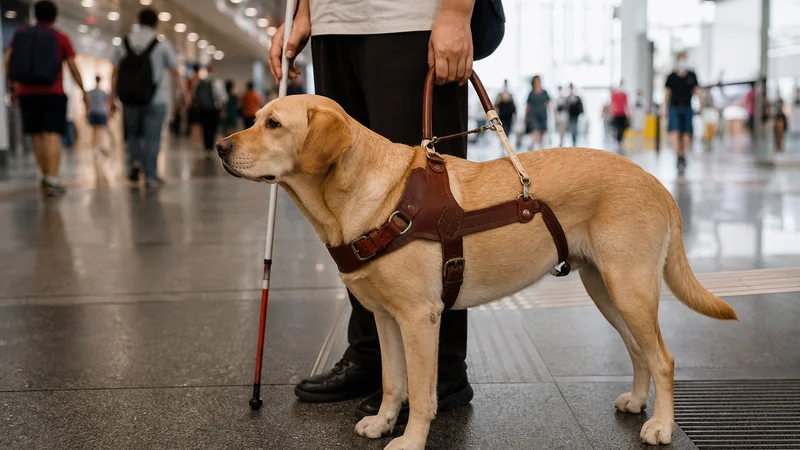
What counts as a guide or assistance dog under Singapore law
The safest approach is to describe the dog’s trained working role and the person’s access need, rather than rely on a broad label. The two official points available here use different language: the transport rule refers to a “guide dog”, while SFA’s updated food-retail guidance refers to “assistance dogs”.
Guide dogs on public buses
The Road Traffic (Public Service Vehicles) rules specifically permit an individual to bring a guide dog into a public bus, also described in the rule as an omnibus. The dog must remain on a leash and under proper control for the entire time the individual stays in the vehicle.
That creates three practical conditions:
- the dog must be a guide dog within the rule’s wording;
- the dog must remain leashed;
- the handler must maintain proper control throughout the journey.
Singapore Attorney-General’s Chambers, Singapore Statutes Online, checked 2026, provides the relevant transport wording. Note that a guide dog is still a dog under Singapore law, so standard dog and cat licensing requirements under the PALS process and mandatory microchipping rules continue to apply alongside any access protection.
Assistance dogs in food retail
The SFA update uses broader wording for licensed retail food establishments. From 1 November 2026, those establishments may permit assistance dogs accompanying people with physical, visual or hearing impairments to enter.
This wording covers more than visual assistance. However, it applies to the specific food-retail guidance described by SFA. It should not automatically be extended to public transport, housing or workplaces.
Singapore Food Agency, 2026, supplies the effective date and the impairment categories in the source provided.

Pet Health Map App
Turn every worry into your pet’s health record
Download the app to save AI Care reports, build your pet’s medical profile, and keep tracking symptoms and care notes.
Android version coming soon. The web version is available now.
Public transport: buses, taxis and the MRT
For guide dog public access law Singapore, the confirmed transport protection in the supplied material applies to public buses. The source does not confirm matching rights for taxis or the MRT, so check each operator before travelling.
Public buses
On a public bus, keep the guide dog leashed and under proper control for the whole journey. Prepare before boarding by ensuring the dog can remain close to you without blocking the aisle or creating a risk for other passengers.
A simple travel check can prevent avoidable disputes:
| Before boarding | During the journey |
|---|---|
| Confirm the dog’s lead and harness are secure | Keep the dog leashed |
| Carry identification or training records if available | Maintain proper control |
| Plan where the dog can settle safely | Avoid unnecessary movement |
| Record the route and time | Note any access problem promptly |
The rule concerns the dog’s control while the individual remains in the vehicle. Therefore, do not treat boarding approval as permission to allow the dog off-lead during the trip.
Taxis and the MRT
The supplied official source does not establish a taxi or MRT entitlement. That does not prove that access is prohibited. It means the evidence available for this guide does not support a definite legal answer.
Consequently, contact the relevant operator before travel and ask for its current assistance-dog policy. Keep a written reply, especially if the journey involves a medical appointment, work shift or flight connection. For the wider rules on taking any pet onto Singapore's public transport network and which pet-friendly venues already welcome animals, see our guide to pets on public transport in Singapore.
Food and beverage outlets: the SFA rule taking effect 1 November 2026
From 1 November 2026, licensed retail food establishments in Singapore may permit assistance dogs accompanying people with physical, visual or hearing impairments to enter. This is the clearest upcoming change in the material supplied for this guide.
What “may permit” means
The phrase does not support a claim that every food outlet must admit every assistance dog. It indicates that the updated SFA food-retail guidance allows such establishments to permit entry in the circumstances described.
Therefore, ask whether the business is a licensed retail food establishment and whether it has implemented the updated guidance. Keep the discussion focused on the dog’s assistance role, not on whether the dog is a pet.
Prepare for a food-outlet visit
Before visiting, prepare:
- The dog’s lead or working harness.
- A short explanation of the dog’s assistance role.
- Any training or identification documentation you already hold.
- The venue’s written response, if you contacted it beforehand.
- A record of the date, time and staff member if access becomes disputed.
The SFA source does not provide a fee, registration process or universal identification document. Do not invent one or assume that a particular certificate is legally required.
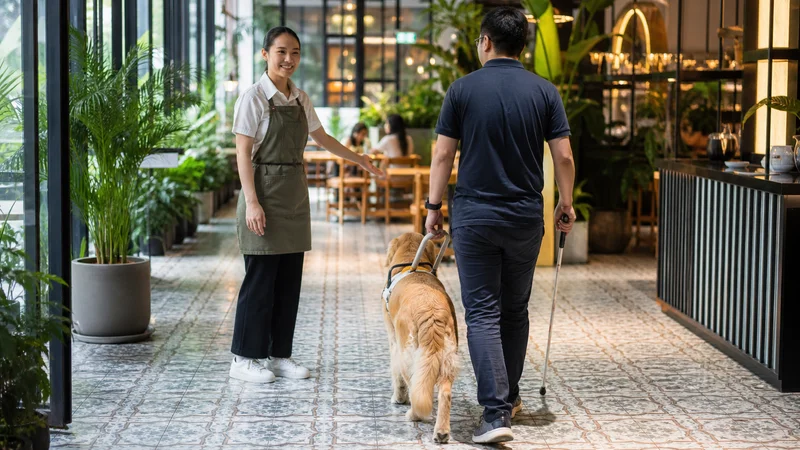
Housing, workplaces and other venues: where the law stays silent
The evidence supplied for this article does not establish a general access rule for housing, offices, shopping centres, hotels, clinics or other venues. Therefore, do not promise a legal entitlement without checking the specific venue, agreement or regulator.
Private housing
Housing arrangements can involve private landlords, building management and written tenancy terms. The available sources do not state a universal Singapore rule requiring every private residence or development to accept a guide or assistance dog.
Ask for the policy in writing and keep relevant correspondence. If the dog supports a disability-related need, explain that need clearly, but avoid claiming that the supplied transport or SFA provisions automatically govern housing.
Workplaces and public venues
Workplace access may depend on the employer’s policy, building management and the specific premises. Similarly, a shopping centre, hotel or clinic may have its own process for working dogs.
Use this evidence checklist:
- venue name and address;
- date and time of the request;
- exact reason given for refusal;
- staff member’s name or description;
- whether the dog remained leashed and controlled;
- photographs or messages, where appropriate;
- copies of any written policy.
This record does not guarantee entry. However, it gives you a clear basis for requesting review and avoids relying on memory after a stressful interaction.
What to do if you are refused entry
A calm, documented response is more useful than an argument at the door. Begin by asking which policy or rule the venue is applying, then request the answer in writing.
Use the ABCD access check
Use this four-part memory hook:
- A — Ask: Ask whether the refusal concerns the dog’s role, control, hygiene or a venue policy.
- B — Briefly explain: State that the dog is a guide or assistance dog and describe the relevant access need.
- C — Capture details: Record the time, location, staff response and any written explanation.
- D — Decide the next step: Contact the operator, venue manager or relevant authority for current guidance.
For a public bus, refer specifically to the leash and proper-control requirement in the Road Traffic rules. For a licensed retail food establishment from 1 November 2026, refer to the updated SFA guidance, while recognising its wording.
Avoid common mistakes
Do not remove the dog’s lead to demonstrate training. Do not claim that the SFA food-retail guidance automatically applies to taxis or the MRT. Also, do not present an unverified certificate, fee or registration requirement as law.
If the situation becomes unsafe, leave if possible and prioritise your welfare and the dog’s welfare. You can then make a written complaint with a precise record of what happened.
Conclusion: check the setting, then carry proof
The confirmed guide dog public access law Singapore position is clearest for public buses: a guide dog may accompany an individual when it remains leashed and under proper control throughout the journey. From 1 November 2026, SFA guidance allows licensed retail food establishments to permit assistance dogs accompanying people with physical, visual or hearing impairments.
However, the supplied sources do not confirm universal rights for taxis, the MRT, housing, workplaces or every venue. Before travelling, contact the relevant operator, keep the reply, and carry the dog’s working identification or training records if available. If refused, use the ABCD check: ask, briefly explain, capture details and decide the next step.