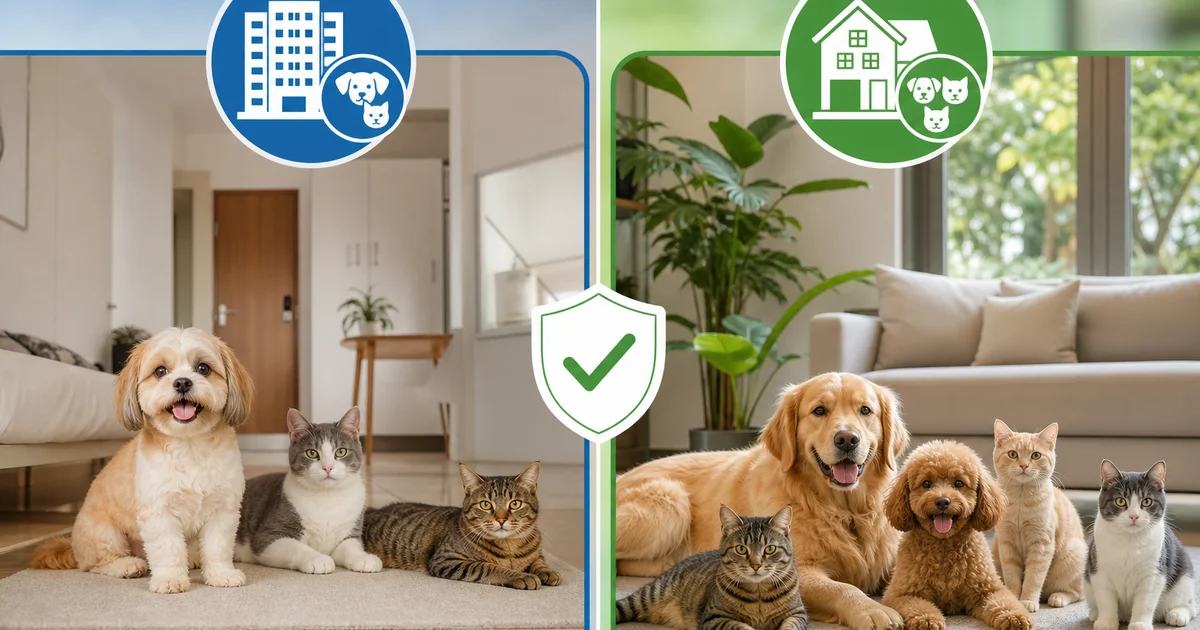
Singapore pet limits depend on your home type. HDB flats allow up to two cats and one approved small-breed dog per residential unit. Private premises allow up to three cats and/or dogs in total. However, licensing, housing rules, and additional condominium by-laws may still affect your situation.
The short answer matters because exceeding the permitted number can create compliance problems, especially if you move between an HDB flat and private property. The practical questions are:
- How many dogs and cats can you keep at each property type?
- What should you do if you already exceed the limit?
- Which licensing, fostering, appeal, or condominium rules need checking?
Use the ABCD check before bringing home another pet: Address, Breed, Count, Documents. It gives you a simple way to identify the rules that apply.
How many dogs HDB flats allow
For an HDB flat, the permitted limit is one HDB-approved small-breed dog and up to two cats per residential unit. The Housing and Development (Animals) Rules 2024 set the relevant animal limit, while HDB confirms that only one dog from its approved-breed list is allowed in each residential unit. (AVS, 2024; HDB, 2024)
That means a flat may generally have:
| Pet combination in one HDB unit | Position under the stated limit |
|---|---|
| One approved small-breed dog | Within the dog limit |
| Two cats | Within the cat limit |
| One approved small-breed dog and two cats | Matches both stated limits |
| Two dogs | Exceeds the one-dog limit |
| One unapproved large-breed dog | Does not match the stated HDB dog requirement |
The breed requirement matters as much as the number of dogs. Therefore, count alone does not confirm compliance. Check whether the dog appears on the current HDB-approved list and confirm the latest licensing position with the relevant authority before relying on an online summary.
Cats also have a separate limit. Since the rules changed from 1 September 2024, cat owners should check the current requirements rather than assume older HDB guidance still applies.
How many dogs HDB owners can keep versus private homes
Private residential premises have a higher combined limit than HDB flats. AVS states that a maximum of three cats and/or dogs may be kept in one private, non-HDB residential, industrial, or commercial premises. (AVS, 2024)
In practical terms, the private-property limit is a combined total, not automatically three dogs plus three cats. For example, the following combinations fit the stated numerical limit:
- Three dogs
- Two dogs and one cat
- One dog and two cats
- Three cats
However, this does not remove other obligations. Each dog or cat may still require the appropriate licence or registration under the current framework. In addition, a condominium may impose its own management rules. Therefore, a private-home owner should check both the AVS position and the property's written by-laws.
The address also matters. A landed home and a condominium are both private premises for the stated AVS ownership limit, but a condominium may involve a management corporation, shared spaces, and building-specific restrictions. Ask the managing agent or MCST for the current written rule before committing to another pet.



Pet Health Map App
Turn every worry into your pet’s health record
Download the app to save AI Care reports, build your pet’s medical profile, and keep tracking symptoms and care notes.
Android version coming soon. The web version is available now.
Why pet limits exist and what happens if you exceed them
The immediate compliance issue is the number and type of animals kept at the address. AVS gives the private-property limit, while the Housing and Development (Animals) Rules 2024 establish the HDB limit. If you fail to comply with HDB's rules, you can face a fine of up to S$4,000. (AVS, 2024)
Do not treat a pet limit as a rough recommendation. It is safer to verify your position before adopting, buying, fostering, or moving an animal into the home. Record the following:
- The full address where each animal lives.
- The species, breed, and number of animals.
- Licence or registration details already held.
- Adoption, fostering, or transfer documents.
- Any written permission or correspondence from the relevant authority or property manager.
If you already exceed the limit, avoid quietly transferring an animal between households without checking the rules. Instead, contact AVS or HDB through the current official channels and ask what action applies to your circumstances.

Cat licensing deadline and the ABCD document check
Cat owners should verify the current licensing deadline and requirements directly with AVS. The supplied official information confirms that cat-ownership rules changed from 1 September 2024, but it does not provide a current deadline or any transition details. Therefore, this article does not guess a date.
The ABCD check helps you prepare:
- Address: Is the property HDB or private, and is it one residential unit or one private premises?
- Breed: If you keep a dog in an HDB flat, is it on the current approved small-breed list?
- Count: How many cats and dogs live at that address altogether?
- Documents: Do you have current licences, adoption records, and written permissions?
Keep digital copies of documents and note the date when you checked the official guidance. This small record can prevent confusion if your household changes or if you move home.
HDB says its rules were updated for cat ownership from 1 September 2024. (HDB, 2024) However, licensing processes and deadlines can change. Consequently, use the current AVS cat-licensing page rather than an old social-media post, adoption listing, or forum comment.
Fostering, appeals and condominium by-laws
Special situations need individual confirmation because the supplied official facts do not set out a universal fostering exemption or appeal pathway. If you foster an animal, ask AVS or HDB whether the arrangement changes the count at the address. Do not assume that temporary care sits outside the ownership limit.
The same caution applies to appeals. The available source information confirms the numerical limits but does not state who qualifies for an appeal, what evidence is required, or whether approval is guaranteed. Therefore, contact the relevant authority before taking in an additional animal.
Condominium residents should also review the property's current by-laws and ask the MCST or managing agent for written clarification. The AVS limit does not tell you whether a particular condominium has additional building rules about pets, lifts, common areas, or nuisance concerns. Those private-property conditions may affect daily management even when your animal count fits the AVS limit.
Prepare this information before making an enquiry:
- Property type and complete address
- Number and species of existing pets
- Dog breed, if applicable
- Proposed fostering or ownership period
- Licence and adoption documents
- The exact question you want answered
That preparation makes the response more useful and leaves a clear record of what you asked.
A practical action plan before adding another pet
The safest approach is to confirm the address, count, breed, and documents before the animal arrives. The following checklist keeps the decision focused:
| Check | What to confirm |
|---|---|
| Address | HDB residential unit or private premises |
| Count | Total cats and dogs already kept there |
| Dog status | HDB-approved small breed, if relevant |
| Cat status | Current licensing and ownership requirements |
| Building rules | Condominium or MCST by-laws |
| Evidence | Licences, adoption papers, and written responses |
Next, check the current AVS and HDB pages. If the information does not answer your situation, contact the relevant authority with the prepared details. Similarly, ask your condominium's managing agent or MCST for its current written rules.
Do this before paying an adoption fee, signing a transfer, or moving an animal into the property. A short verification can prevent an avoidable compliance problem and may identify a required licence or permission early.
Conclusion: confirm your count before bringing a pet home
The answer to how many dogs HDB residents can keep is one approved small-breed dog per residential unit, alongside up to two cats under the stated HDB and AVS limits. Private premises allow up to three cats and/or dogs in total. (AVS, 2024; HDB, 2024)
However, the number is only the starting point. Check the dog's approved-breed status, current cat-licensing requirements, and any condominium by-laws. If you foster, appeal, or already exceed a limit, contact AVS or HDB before making changes.
Use the ABCD check—Address, Breed, Count, Documents—then verify the latest official guidance. That simple process gives you a clearer answer before another pet joins your household.