Moving a dog, cat or small mammal overseas involves more than booking a flight. Singapore's Animal & Veterinary Service (AVS) requires an export licence before an animal leaves Singapore, while the destination country sets its own import conditions.
To export pet from Singapore, check the destination's import rules, obtain the required AVS export licence, then arrange the veterinary health certificate and any destination-specific tests. The AVS licence remains valid for 90 days from its issue date, so coordinate the application with your travel schedule.
This guide solves three common problems: understanding what the AVS licence does, separating Singapore's requirements from the destination country's rules, and planning costs and timing without relying on guesswork.
Export pet from Singapore: what the AVS licence covers
The bottom line is simple: the AVS export licence authorises your dog or cat to leave Singapore, but it does not automatically satisfy the destination country's entry requirements.
AVS states that owners must apply for and obtain an export licence before their dog or cat leaves Singapore. This applies whether the animal is relocating, travelling or being exported for commercial purposes (Animal & Veterinary Service, NParks, 2026).
The same principle matters for small mammals. AVS places the export licence within a wider process that also includes destination-country requirements and a veterinary health certificate. Therefore, treat the licence as one part of the export file rather than the complete travel approval.
The licence has a 90-day validity period from its issue date (Animal & Veterinary Service, NParks, 2026). Consequently, applying too early can create a timing problem if your departure falls outside that window.
What the licence does not replace
An AVS licence does not replace:
- The destination country's import permit, if required
- Required vaccinations or laboratory tests
- A veterinary health certificate
- Airline or carrier documentation
- Transport-compliant crate arrangements
- Any quarantine or post-arrival conditions set by the destination
Requirements differ by destination and species. A dog travelling to Australia may face a different process from a cat travelling to the United Kingdom or a small mammal travelling elsewhere. Check the destination authority's current instructions before paying for tests.
Step 1: Check destination import requirements first
The most important practical step is to start with the destination country, not the airline and not the AVS application. AVS specifically states that owners should check the destination country's animal import requirements before applying for the export licence (Animal & Veterinary Service, NParks, 2026).
Build a destination requirement sheet
Create one page for your pet's move and record:
| Item to confirm | What to record |
|---|---|
| Species and breed | Dog, cat or small mammal; include breed details |
| Identification | Microchip details, where relevant to the destination |
| Health requirements | Vaccinations, examinations and certificates |
| Laboratory requirements | Tests, sample timing and approved laboratories |
| Import approval | Whether the destination requires an import permit |
| Arrival conditions | Quarantine, inspection or post-arrival obligations |
| Transport rules | Airline crate, route, transit/layover permit requirements, and documentation |
Do not assume that rules for dogs also apply to cats. Similarly, do not assume that a country's general pet-travel page covers commercial exports or unusual species.
Check dates, not just documents
Some requirements depend on when a vaccination, test or health examination occurs. Record the earliest and latest acceptable dates beside each requirement. Then work backwards from your intended arrival date.
As a practical safeguard, save the destination authority's webpage as a PDF or screenshot. Requirements can change, and a dated record helps you identify which instructions you followed. However, always confirm the current version before departure.



Pet Health Map App
Turn every worry into your pet’s health record
Download the app to save AI Care reports, build your pet’s medical profile, and keep tracking symptoms and care notes.
Android version coming soon. The web version is available now.
Step 2: Apply for the AVS export licence
Once you understand the destination conditions, apply for the AVS export licence before your pet leaves Singapore. The licence must be obtained before departure, not merely requested.
Match the application to your travel plan
The AVS licence is valid for 90 days from its issue date. Therefore, choose an application date that leaves enough time for veterinary work while keeping the licence valid on departure day.
Keep these details together before applying:
- Your confirmed or provisional departure date
- Your pet's identifying information
- The destination country and final arrival point
- The destination's import instructions
- Any details needed for the veterinary certificate
If your plans change, reassess the validity window rather than assuming the existing licence remains suitable. A new travel date may require confirmation from AVS.
Understand the licence fee
A Singapore-based pet relocation agency reports a standard AVS export licence fee of S$50, with an express service option reported at S$100 (Asiatic International Relocation Pte Ltd, 2026). Because service options and charges can change, confirm the current amount and available processing route with AVS before applying.
The licence fee represents only one part of the overall budget. Veterinary appointments, laboratory testing, import permits, transport crates, airline charges and professional relocation support may add separate costs.
Accordingly, ask each provider for an itemised quotation. This approach makes it easier to distinguish government charges from veterinary and transport expenses.
Step 3: Arrange the health certificate and veterinary checks
After securing the destination requirements and applying for the licence, arrange the veterinary health certificate. AVS identifies obtaining this certificate as the next stage of its export process for small mammals, after checking destination rules and obtaining the export licence (Animal & Veterinary Service, NParks, 2026).
Give your vet the destination instructions
Take the destination authority's written requirements to your veterinary practice. Do not ask for a generic "fit-to-fly" letter and assume it will meet border requirements. The destination may require particular wording, examination timing, tests or endorsements.
Ask the practice to confirm:
- Which examination, microchip standard (e.g., ISO 11784/11785), and tests your destination requires
- When the examination should occur
- Which documents the vet must complete
- Whether any authority endorsement is needed
- How long the completed paperwork remains acceptable
The precise requirements depend on the destination, species and travel purpose. Therefore, your veterinary practice should work from the destination's official instructions rather than a general checklist.
Allow for destination-specific testing
Some destinations require additional biosecurity testing beyond the AVS export licence. A Singapore-based relocation agency reports that Australia may require testing including Brucella canis testing as part of its import process (Asiatic International Relocation Pte Ltd, 2026).
That requirement should not be generalised to every destination or every animal. Confirm the current Australian conditions, including whether they apply to your dog's circumstances, before arranging laboratory work.
Keep copies of certificates, test reports, vaccination records and identification details. Place the originals in a waterproof document wallet, and retain digital copies separately.
Export pet from Singapore: costs and typical timeline
The safest budget approach is to separate fixed known charges from variable professional, veterinary and travel costs. The available Singapore guidance confirms the AVS licence fee reported by a local relocation agency, but your total cost depends on destination requirements.
Known and variable costs
| Cost category | Planning position |
|---|---|
| Standard AVS export licence | S$50 reported for 2026 |
| Express AVS service | S$100 reported for 2026 |
| Veterinary consultation | Varies by practice and services |
| Laboratory testing | Varies by test and laboratory |
| Destination import permit | Depends on destination rules |
| Crate and airline transport | Depends on route, carrier and pet size |
| Relocation agency | Optional; varies by service scope |
The S$50 and S$100 figures come from Asiatic International Relocation Pte Ltd's 2026 guide, not from the AVS source supplied here. Confirm current charges directly before relying on them.
Use a three-date planning model
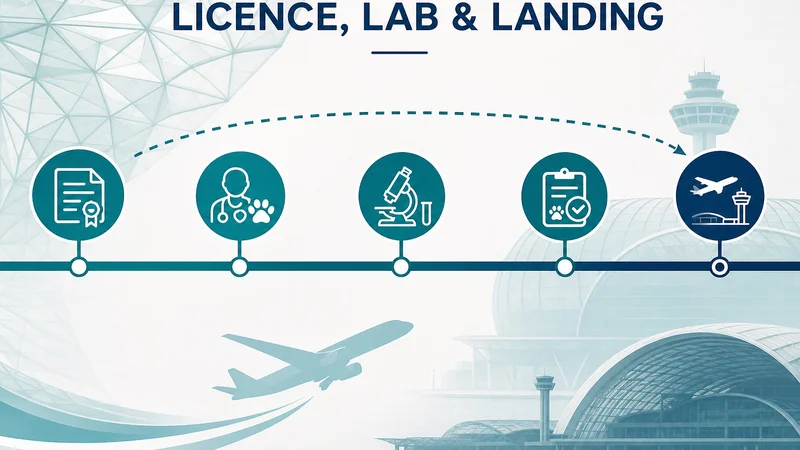
A useful memory hook is the Licence–Lab–Landing check:
- Licence: When will the AVS licence be issued, and will it remain valid on departure?
- Lab: When must tests and veterinary checks occur?
- Landing: What must remain valid on arrival?
This model exposes common clashes. For example, a test may need to occur within a narrow window, while the AVS licence has its own 90-day validity period. Build your schedule around the strictest date, not the easiest one.
Common mistakes that delay export
Most delays begin with a mismatch between Singapore's export process and the destination's import process. Avoiding that mismatch protects both your schedule and your pet's welfare.
Mistake 1: Applying before checking the destination
An AVS licence cannot tell you whether the destination accepts your documents, requires testing or imposes arrival conditions. Check the destination rules first, as AVS advises.
Mistake 2: Treating a health certificate as generic
A certificate that confirms general health may not contain the wording or timing the destination authority expects. Give your vet the official import instructions.
Mistake 3: Ignoring the 90-day licence window
Record the licence issue date immediately. Then compare it with the departure date and allow time to resolve paperwork problems.
Mistake 4: Budgeting only for the licence
The licence may be a small part of the total cost. Ask about veterinary work, testing, import permits, transport, crates and optional relocation assistance.
Mistake 5: Leaving documents in separate places
Create one export folder with paper and digital copies. Include the licence, health certificate, test reports, vaccination records, identification details and destination approvals.
If uncertainty remains, contact AVS and the destination authority before booking non-refundable travel. Requirements can change, and a confirmed answer is safer than relying on an old checklist.
Conclusion: make your export file date-led
To export pet from Singapore smoothly, organise the move around three checkpoints: destination rules, the AVS export licence and the veterinary health certificate. The AVS licence must be obtained before departure and remains valid for 90 days, while destination-specific tests and documents may create the tightest deadlines.
Start by building a Licence–Lab–Landing checklist. Then confirm current AVS charges, give your vet the destination's written requirements, and keep every document in one export file. If your route includes Australia or another destination with biosecurity testing, verify the latest conditions before arranging laboratory work. Contact AVS and your veterinary practice early to confirm the steps that apply to your pet.