Stray Feeding Rules Singapore: 5 Rules for Cat Caregivers
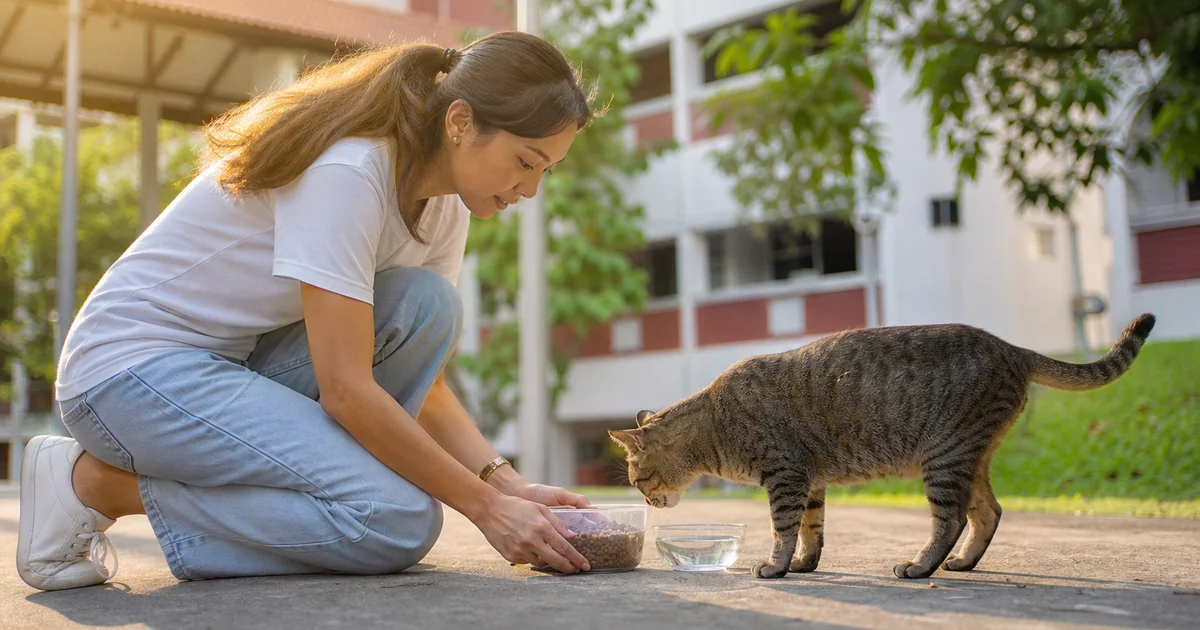
If you are searching for stray feeding rules Singapore, the short answer is clear: feeding community cats is not illegal. However, caregivers must prevent littering, remove leftover food and containers, and avoid feeding wildlife. Singapore’s TNRM programme also supports humane sterilisation, microchipping and population management through AVS and partner Animal Groups.
The confusion usually comes from three separate issues. You need to know whether the animal is a community cat or wildlife, what responsible feeding involves, and which penalties can apply when food or water creates a public-health problem. The following guide explains the practical rules, current TNRM support and the safest way to request help.
Stray feeding rules Singapore: is feeding community cats legal?
Feeding community cats is permitted, but leaving waste behind can become an offence. The legal risk does not come from feeding a community cat itself. Instead, it may arise when a caregiver fails to clear leftover food or containers.
A parliamentary written answer from Singapore’s Ministry for the Environment states that people who feed stray animals without clearing leftover food or food containers may face a fine of up to S$2,000 for a first offence under the Environmental Public Health Act (National Archives of Singapore, 2017).
Mothership’s report on a Clementi incident also distinguishes lawful cat feeding from littering caused by uncleared food. Therefore, a caregiver should treat every feeding point as a shared public space, not a private bowl area.
Community cats and wildlife follow different rules
Do not apply cat-feeding practices to wild animals. NParks states that feeding wildlife, including wild boars, macaques and pigeons, anywhere in Singapore can attract a fine of up to S$10,000 under the Wildlife Act (NParks, accessed 2026).
| Animal or situation | Relevant rule |
|---|---|
| Community cat | Feeding is not illegal, but keep the area clean |
| Wildlife | Do not feed; Wildlife Act penalties may apply |
| Leftover food or containers | May lead to enforcement under public-health law |
In other words, identify the animal before putting food down. A community cat near a housing estate is not treated in the same way as wildlife in a park or nature reserve.
How Singapore’s TNRM programme manages community cats
TNRM combines sterilisation with identification and ongoing caregiving. The programme means Trap-Neuter-Release-Manage. AVS launched Singapore’s TNRM programme on 1 September 2024, replacing the Stray Cat Sterilisation Programme that had operated since 2011 (AVS, accessed 2026).
Sterilisation helps prevent further litters. The “manage” element also matters because caregivers can monitor cats, arrange treatment and report changes in the local population.
What happens during TNRM
A typical TNRM request may involve:
- Identifying the cat and its regular location.
- Arranging humane trapping.
- Transporting the cat for veterinary assessment and sterilisation.
- Microchipping the cat where appropriate.
- Providing necessary treatment.
- Returning the cat to its familiar territory when safe.
Microchipping and registration with AVS can improve traceability, according to AVS guidance on living harmoniously with community cats (AVS, accessed 2026). Keep a simple record of the cat’s coat pattern, sex, approximate age, feeding location and any health concerns. These details help an Animal Group identify the correct cat.

Use the ABCD check before requesting help
A practical memory hook is the ABCD check:
- A — Area: record the exact block, street or landmark.
- B — Body: note sex, size, coat markings and visible injuries.
- C — Condition: record appetite, mobility, breathing and unusual behaviour.
- D — Date: write down when you last saw the cat and whether it appears regularly.
This avoids a common first-timer mistake: reporting “a sick stray cat” without enough information to locate it.


Pet Health Map App
Turn every worry into your pet’s health record
Download the app to save AI Care reports, build your pet’s medical profile, and keep tracking symptoms and care notes.
Android version coming soon. The web version is available now.
AVS TNRM support, sterilisation and trapping costs
AVS provides reimbursement caps to partner Animal Groups, rather than a universal cash payment to every member of the public. The available support covers several TNRM-related services.
AVS lists the following reimbursement caps for partner Animal Groups (AVS, accessed 2026):
| Service | Reimbursement cap |
|---|---|
| Microchipping | Up to S$30 |
| Routine sterilisation, male cat | Up to S$110 |
| Routine sterilisation, female cat | Up to S$230 |
| Complex sterilisation | Up to S$350 |
| Necessary treatment | Up to S$110 |
| Boarding | Up to S$40 per day |
| Trapping, adult cat | Up to S$100 |
| Trapping, kitten | Up to S$30 |
These figures are caps for the programme. They should not be treated as a guaranteed cash allowance or as the final price charged by every clinic.
How to request free trapping and sterilisation
Members of the public can request free trapping and sterilisation assistance through Cat Welfare Society at [email protected], according to AVS’s community-cat information (AVS, accessed 2026).
Partner Animal Groups listed by AVS include:
- Cat Welfare Society, the lead partner
- Causes for Animals Singapore
- LUNI Singapore
- Noah’s Ark Cares
- Purely Adoptions
- SPCA
Before contacting a group, prepare photographs, the ABCD details and information about whether the cat has already been sterilised. Also mention if the cat is nursing, injured or difficult to approach.
Responsible feeding guidelines for community cats
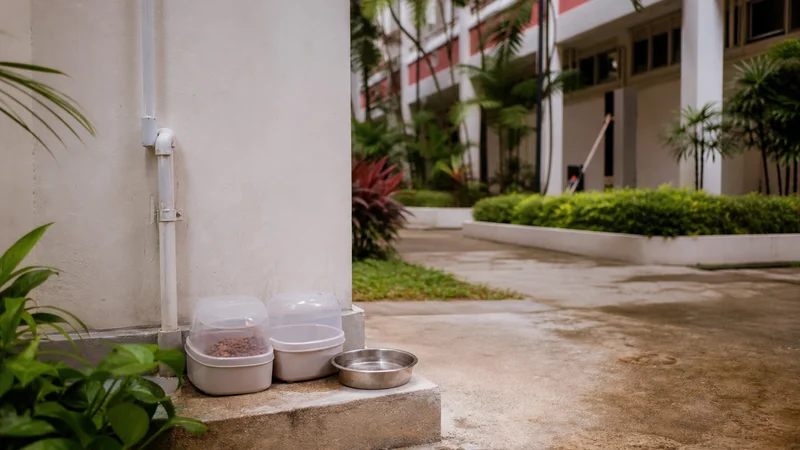
Feed in a controlled, cleanable way, then remove the feeding setup promptly. Cat Welfare Society recommends feeding only cat food, placing it in containers rather than directly on the ground, and clearing food and containers within two hours (Cat Welfare Society, current guidance, accessed 2026).
Fresh water also needs daily attention. Pour out the previous day’s water and wipe the container before refilling it. This helps prevent mosquito larvae and keeps the feeding point cleaner.
The two-hour feeding routine
Use this simple routine at each feeding point:
- Put out an appropriate amount of cat food in a container.
- Provide fresh water in a clean container.
- Note how much the cats eat.
- Return within two hours.
- Remove leftovers and containers.
- Wipe spills and check the surrounding area.
- Pour away old water and clean the water container.
Do not leave large amounts of food “for later”. It can attract insects, rodents and complaints from neighbours. In addition, spoiled food may make cats unwell.
Keep a feeding record
A short log can identify problems early. Record the date, approximate amount offered, amount left, number of cats seen and any unusual symptoms. Pay particular attention to breathing difficulty, persistent diarrhoea, limping, open wounds or sudden withdrawal.
However, do not handle an unfamiliar or frightened cat unnecessarily. Contact an Animal Group for guidance if trapping or veterinary assessment may be needed.
Fines and enforcement: what behaviour creates risk?
The main enforcement distinction is between lawful community-cat feeding, wildlife feeding and littering. These are separate situations with different authorities and penalties.
| Behaviour | Likely issue | Published maximum or guidance |
|---|---|---|
| Feeding a community cat and clearing the area | Responsible caregiving | Not illegal according to the cited guidance |
| Feeding wildlife | Wildlife feeding offence | Up to S$10,000 under the Wildlife Act |
| Leaving food or containers behind | Littering or public-health offence | Up to S$2,000 for a first offence, according to the parliamentary record |
| Leaving neglected water | Mosquito-breeding concern | CWS says continued violations may be referred to NEA |
Cat Welfare Society explains that non-compliant caregivers should be guided first. Continued violations, particularly neglect involving mosquito-breeding water, may be referred to the National Environment Agency (Cat Welfare Society, current guidance, accessed 2026).
Therefore, a complaint does not automatically mean that feeding itself was unlawful. The details matter: what animal was fed, where it was fed, what remained afterwards and whether the area created a public-health concern.
Getting help from Animal Groups in Singapore
Contact a partner Animal Group when sterilisation, trapping or medical assessment exceeds your ability to manage safely. Do not improvise with makeshift traps or chase a frightened cat through traffic.
The AVS-listed partner groups can support community-cat population management. Cat Welfare Society is the named contact for public requests for free trapping and sterilisation through [email protected] (AVS, accessed 2026).
Prepare these details before contacting a group
Include:
- Exact location and nearby landmark
- Clear photographs, if safe to obtain
- Number of cats present
- Sex and approximate size
- Ear-tipping status, if visible
- Whether the cat is friendly, fearful or aggressive
- Signs of injury, illness or pregnancy
- Usual feeding time
- Whether neighbours or other caregivers are involved
The outline sources do not establish a separate formal “registered caregiver” application process for every member of the public. Therefore, check current AVS or partner Animal Group guidance before assuming that a registration card, licence or approval is required.
Conclusion: follow the five-point caregiver rule
The safest interpretation of stray feeding rules Singapore is simple: feeding community cats is allowed, but responsible caregiving is expected. Feed cat food in containers, provide fresh water, clear everything within two hours and never feed wildlife. Keep records so an Animal Group can identify cats that need TNRM support.
If a cat needs sterilisation, trapping or treatment, contact Cat Welfare Society or another AVS-listed partner Animal Group. Before you feed, use the ABCD check: Area, Body, Condition and Date. That small preparation makes practical help faster while protecting cats, neighbours and shared spaces.