
Exotic Pet Ownership Law in New Zealand: 5 Checks
Exotic pet ownership law in New Zealand depends on the animal's species, wildlife status, biosecurity classification and origin. Native wildlife generally needs DOC authorisation, while unwanted or prohibited organisms can create serious legal problems. Before acquiring an unusual animal, check DOC guidance, the Official New Zealand Pest Register and MPI requirements.
The main challenge is that "exotic pet" is a practical description, not one single legal category. A reptile, bird, mammal or amphibian may be regulated under different laws, and the same animal can trigger wildlife, biosecurity or import rules at once.
What the exotic pet ownership law in New Zealand covers
The law focuses on the animal’s legal status, not whether a seller calls it exotic, unusual or captive-bred. In practice, you need to identify the species and then check whether it is protected wildlife, an unwanted organism or a prohibited new organism.
The Wildlife Act 1953 protects more than 930 native species, including native birds, bats, frogs and reptiles. It also covers 71 introduced bird, mammal, reptile and amphibian species currently living wild in New Zealand. DOC places wildlife into three broad protection tiers:
- Absolutely protected wildlife
- Wildlife with varying levels of protection
- Unprotected wildlife
Therefore, a private owner should not assume that a captive-bred animal falls outside wildlife controls. The species and its legal classification remain central.
The Environmental Protection Authority (EPA) also identifies some organisms as prohibited from entering New Zealand. Snakes, squirrels and sticklebacks are prohibited new organisms. EPA guidance states that some organisms present such a high environmental risk that they must not be imported, developed, field-tested or released.
DOC and EPA guidance, current in 2026, should be treated as separate checks. A species might raise wildlife concerns, biosecurity concerns or both.
Exotic pet ownership law in New Zealand: what can you legally keep?
Some unusual animals may be kept lawfully, but legality depends on the species, its protection status and any required authorisation. New Zealand does not offer one simple list that makes every “exotic” pet legal or illegal.
For example, DOC states that anyone wanting to hold protected wildlife must apply for a permit. It also specifically requires Wildlife Act authorisation to privately hold lizards or kakariki. A General Authorisation registration exists for certain common lizard species without an individual permit application.
That does not mean every lizard qualifies. You must identify the exact species and follow the relevant DOC process. A common name used by a seller may not provide enough certainty.
Three questions to ask about any species
Use this short CLEAR check before paying a deposit:
| Check | Question |
|---|---|
| C — Classification | What is the animal’s exact scientific name? |
| L — Legal status | Is it protected wildlife, an unwanted organism or a prohibited new organism? |
| E — Entry | If imported, does MPI allow its entry and under what conditions? |
| A — Authorisation | Do DOC, MPI or another authority require permission? |
| R — Records | Can the seller provide lawful origin and ownership records? |
This approach prevents a common beginner’s mistake: researching care requirements before confirming whether ownership is permitted. If the seller cannot provide the scientific name, pause the purchase.


Pet Health Map App
Turn every worry into your pet’s health record
Download the app to save AI Care reports, build your pet’s medical profile, and keep tracking symptoms and care notes.
Android version coming soon. The web version is available now.
Banned and restricted exotic animals
Do not confuse “restricted” with “difficult to care for”; restricted animals may require formal permission, while prohibited organisms cannot simply be brought into New Zealand. The legal consequence depends on the animal’s classification.
Ferrets provide a clear example. DOC classifies ferrets as an unwanted organism. Since 2002, New Zealand has banned their sale, distribution and breeding as domestic pets. MPI states that handling an unwanted organism requires permission, and that breeding, selling or releasing one is an offence under the Biosecurity Act 1993.
Snakes, squirrels and sticklebacks are listed by EPA as prohibited from entering New Zealand as new organisms. Consequently, importing one is not a normal pet-owner process. These controls exist because an escaped or released exotic animal can threaten native species in the same way domestic cats do — see our guide on cat containment rules and Predator Free 2050 for how councils already manage that risk for a common companion animal.
Why “captive-bred” does not settle the question
Captive breeding may describe an animal’s origin, but it does not automatically remove legal controls. Similarly, an animal already living overseas is not necessarily eligible for import.
Avoid relying on:
- A social-media post claiming an animal is legal
- A seller’s statement that “many people own them”
- A foreign licence
- A pet shop listing without a scientific name
- An assumption that a small species creates little environmental risk
Instead, check the relevant official register and ask the authority for written clarification where the classification remains unclear.
How DOC and MPI permits work
DOC and MPI deal with different risks, so one authority’s approval may not replace the other’s. DOC focuses on protected wildlife and wildlife authorisations. MPI manages biosecurity risks involving unwanted organisms and entry into New Zealand.
DOC says anyone wanting to hold protected wildlife must apply for a permit. Its guidance also identifies Wildlife Act authorisation for private ownership of lizards or kakariki, with General Authorisation registration available for certain common lizard species.
MPI states that permission is needed to handle an unwanted organism. It also directs people to the Official New Zealand Pest Register (ONZPR) to check an organism’s status before acquisition.
Prepare before contacting an authority
Have these details ready:
- The exact scientific name
- The animal’s country of origin
- Whether it is captive-bred or wild-caught
- Your intended location and purpose
- Whether you plan to breed, sell or move it
- Any seller documents or previous permits
This information helps distinguish an ownership question from an import or biosecurity question. Do not acquire the animal while waiting for an answer unless the authority confirms that doing so is lawful.
Bringing an exotic pet into New Zealand
Importing an animal requires a separate check from domestic ownership, and you should confirm the current MPI pathway before making arrangements. Entry rules can depend on the species, origin, health risks and biosecurity classification.
The EPA states that prohibited new organisms cannot enter New Zealand. MPI also warns that unwanted organisms require permission to handle, and the ONZPR provides a way to check an organism’s status before acquisition.
Because import requirements can change, avoid relying on an old forum post or overseas export certificate. A seller abroad may understand the exporting country’s rules but not New Zealand’s requirements. If you are also planning to bring a dog or cat into the country at the same time, see our separate guide to bringing a dog or cat into New Zealand under MPI's import and quarantine standards, since the biosecurity pathway and timelines differ from those for an exotic species.
Import decision sequence
Follow this order:
- Identify the species scientifically.
- Check its status on the ONZPR.
- Check EPA information for prohibited new organisms.
- Check DOC guidance if the animal is protected wildlife.
- Contact MPI about current import requirements.
- Obtain written approvals before shipment.
- Confirm transport, quarantine and documentation requirements directly with MPI.
If any step produces uncertainty, stop the transaction. Returning or surrendering an animal after arrival may not solve the legal or welfare problem.
The practical ownership checklist
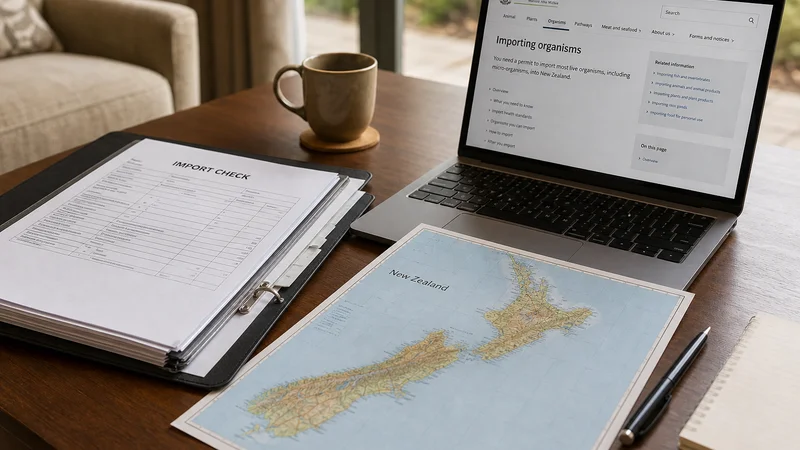
The safest purchase is one you can document before the animal changes hands. Legal ownership also depends on your ability to maintain accurate records and comply with any conditions attached to an authorisation.
Use this pre-purchase checklist:
- Record the animal’s scientific and common names.
- Ask how and where the animal was bred.
- Request proof of lawful origin.
- Check DOC guidance for protected wildlife.
- Search the ONZPR for biosecurity status.
- Check EPA information for prohibited organisms.
- Ask whether breeding, sale or transfer needs additional permission.
- Confirm enclosure, food and veterinary arrangements.
- Save emails, permits, registrations and receipts.
- Confirm the rules again before moving the animal between owners.
The most common first-time mistake is treating a verbal assurance as approval. Keep the original documents, not just screenshots of an advert. Also, ask the authority what happens if the animal escapes, dies or can no longer be kept.
Do not release an unwanted or non-native animal. MPI specifically identifies release as an offence for unwanted organisms. If you believe an exotic animal is being kept, bred or sold unlawfully, or an animal's welfare is at risk, our guide on how and where to report animal cruelty in New Zealand explains who to contact and what information to prepare.
What to do before you commit
If you cannot verify the species and its legal pathway, do not buy it yet. A careful delay protects you, the animal and New Zealand’s environment.
Start with the CLEAR check, then contact the relevant authority with precise information. DOC guidance is the starting point for protected wildlife and private holding authorisations. MPI is the starting point for unwanted organisms and biosecurity questions. EPA information helps identify prohibited new organisms.
Remember that “exotic pet” is not a legal guarantee of either permission or prohibition. The answer depends on classification, purpose and movement of the animal.
The exotic pet ownership law in New Zealand can involve more than one framework. Check the current 2026 guidance before paying a deposit, importing an animal or accepting a transfer. If the rules remain unclear, obtain written confirmation from DOC or MPI rather than relying on a seller’s interpretation.