
Cat Containment NZ: A Practical 2026 Guide
If you are searching for cat containment NZ rules, start with your city or district council. New Zealand does not yet have one nationwide companion-cat containment law. Local bylaws may set requirements for microchipping, desexing, registration or containment, while national predator-control policy distinguishes feral cats from owned pets.
Cats can live safely alongside native wildlife, but owners must understand where council rules apply and what Predator Free 2050 actually targets. This guide solves three common problems:
- separating national conservation policy from local cat bylaws;
- checking whether a rule applies to your address; and
- choosing practical steps that protect your cat and vulnerable wildlife.
Why cat containment NZ is a conservation issue
The bottom line is simple: responsible ownership matters because New Zealand wildlife evolved without mammalian predators. The Department of Conservation explains that native species developed for millions of years without those predators or effective defences against them (Department of Conservation, accessed 2026).
SPCA New Zealand estimates that approximately 1.2 million companion cats live in more than a third of New Zealand households. It also reports that as little as half of owned cats are microchipped. That creates practical problems when cats become lost, sick or separated from their owners.
Unplanned breeding adds further pressure. SPCA says 70% of incoming animals involve unplanned litters or lost and sick cats. Therefore, desexing and identification form part of a wider wildlife and animal-welfare response.
A useful way to remember the issue is the ABCD check:
| Check | Question |
|---|---|
| A — Address | Which council controls your property? |
| B — Bylaw | What does its current animal-keeping rule require? |
| C — Cat status | Is your cat owned, stray, or feral? |
| D — Defence | How will you prevent roaming and unplanned litters? |
This avoids treating every cat as a conservation-policy target or assuming every council uses identical rules.
Predator Free 2050 and feral cats
Predator Free 2050 is a national conservation goal, not a general order to remove owned companion cats. DOC describes the programme as aiming to eradicate the most harmful introduced predators from the whole country by 2050. Its core target species include rats, possums and stoats (Department of Conservation, accessed 2026).
Feral cats have also been added to the strategy, according to Farmers Weekly’s report of the Conservation Minister’s announcement (Farmers Weekly, accessed 2026). However, that does not mean the strategy treats a registered household cat in the same way as an unowned, self-sustaining feral population.
The distinction matters for owners:
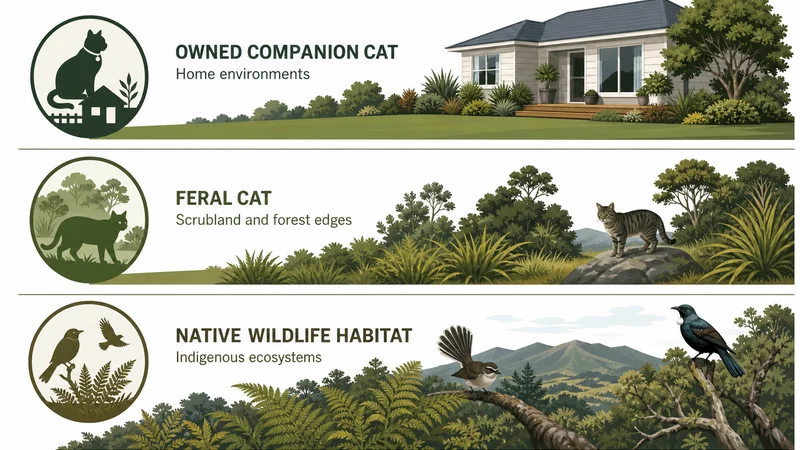
- Owned companion cat: an animal kept by a person or household.
- Feral cat: a cat living without meaningful human ownership or control.
- Local council issue: rules affecting how residents keep animals at home.
- National conservation issue: protection of native species from introduced predators.
Consequently, read Predator Free 2050 as a landscape-scale conservation framework. Read your council’s animal bylaw as the place to check household obligations. Confusing those two systems can lead to unnecessary fear or, conversely, to missed local requirements.


Pet Health Map App
Turn every worry into your pet’s health record
Download the app to save AI Care reports, build your pet’s medical profile, and keep tracking symptoms and care notes.
Android version coming soon. The web version is available now.
Cat containment NZ rules come from councils
The practical source for cat containment NZ requirements is your local council’s current animal or “Keeping of Animals” bylaw. Do not assume that a rule applying in one city automatically applies in another district.
Porirua City Council provides a clear example. It adopted a new Keeping of Animals Bylaw on 26 June 2025, with commencement scheduled for 1 July 2025 (Porirua City Council, 2025). That example demonstrates why owners should check both the adoption date and the commencement date when reading a council notice.
Before relying on a social-media post or an old tenancy discussion, check:
- your council’s official website;
- the current Animals or Keeping of Animals bylaw;
- any implementation date;
- rules applying to your property type; and
- contact details for clarification.
A council webpage may separate general animal-keeping information from the enforceable bylaw. Therefore, save the relevant page or download the current document. Record the date you checked it, especially if you are moving house or adopting a cat.
If the wording remains unclear, ask the council in writing. Keep the reply with your cat’s veterinary records. That simple habit gives you a reliable reference instead of relying on memory.
What national cat-law proposals mean now
The immediate answer is that a proposed national requirement is not the same as an enacted national law. SPCA New Zealand reports that an Environment Select Committee recommended legislation requiring companion cats to be desexed and microchipped after a public petition. SPCA welcomed that recommendation (SPCA New Zealand, accessed 2026).
For owners, the sensible response is preparation rather than panic. You do not need to treat a recommendation as a current nationwide deadline. Instead, check the rule that applies in your council area and ask your veterinary practice what records your cat needs.
A practical readiness list includes:
- microchip identification details;
- confirmation that the registration information is current;
- desexing or veterinary records;
- your council’s bylaw page;
- your cat’s usual escape routes; and
- a plan for safe outdoor access.
This approach also helps if national policy changes later. An owner who already keeps accurate records can respond more easily than one who waits for a deadline.
Do not guess at eligibility, fees or dates. Requirements can change, and the supplied sources do not establish a nationwide commencement date or a standard price. Instead, check the current government, council or veterinary information before acting on a claim.
Building safer containment for cats and wildlife
The best cat containment NZ plan matches the cat’s behaviour, the property and the nearby environment. A secure outdoor enclosure, often called a catio, can provide fresh air without allowing unrestricted roaming. Cat-proof fencing may also help, although its suitability depends on the layout and the individual cat.
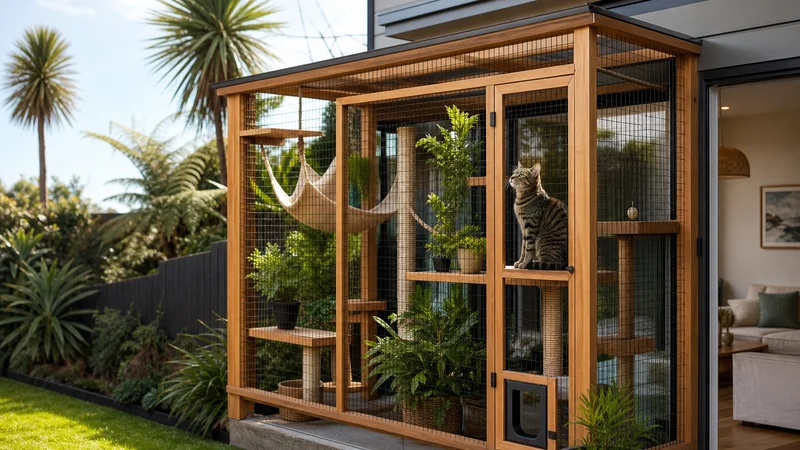
Start with an inspection rather than buying equipment immediately:
- mark doors, windows and gates your cat can use;
- identify rooflines, trees and low walls that support climbing;
- check whether visitors can leave an escape route open;
- note nearby bush, reserves or areas where wildlife may be vulnerable; and
- decide whether indoor enrichment needs improvement.
Next, introduce changes gradually. Provide scratching surfaces, climbing points, hiding areas and regular play. A cat that has suitable stimulation indoors may adapt more easily to a contained routine, although each animal responds differently.
Microchipping remains valuable even where you are unsure whether a local rule requires it. SPCA’s information indicates that many owned cats are not microchipped, while lost or sick cats contribute to shelter intake (SPCA New Zealand, accessed 2026). Therefore, confirm that the chip is registered to your current contact details.
Desexing also helps prevent unplanned litters. Ask a veterinary practice about timing, recovery and any factors specific to your cat.
A practical action plan for cat owners
The most useful next step is to complete the ABCD check within one sitting. It turns a broad conservation debate into a manageable household task.
| Step | Action | Evidence to keep |
|---|---|---|
| A — Address | Identify your city or district council | Council name and website |
| B — Bylaw | Read the current animal-keeping rules | Saved link or downloaded document |
| C — Cat status | Confirm ownership, microchip and desexing records | Veterinary and registration records |
| D — Defence | Reduce roaming with secure containment | Photos or a written home plan |
Then contact the council if the bylaw uses terms you do not understand. Ask specifically whether the rule applies to your property and whether a commencement date or transition arrangement matters.
After that, contact your veterinary practice about microchipping or desexing if either remains outstanding. Fees vary by practice, so call ahead rather than relying on an online estimate.
Finally, review the plan after moving house, adopting another cat or changing outdoor access. The animal-keeping rule may depend on the council area, while the practical containment risk can change with the property. Keep the plan realistic: a secure enclosure that you maintain consistently is more useful than an ideal system you cannot manage.
Conclusion: make cat containment a routine
Cat containment NZ decisions sit at the intersection of local council rules, companion-animal welfare and national conservation. Predator Free 2050 targets harmful introduced predators, including feral cats, but it should not be confused with a nationwide order applying identically to every owned cat.
Use the ABCD check: confirm your address, read the current bylaw, verify your cat’s records and choose a practical defence against roaming. Check official council information before relying on older advice, and ask your veterinary practice about microchipping, registration and desexing. Start today by saving your council’s current animal-keeping page and inspecting your property for escape routes.