Buying a Puppy in New Zealand: Breeder Rules, Red Flags and What to Ask
Buying a puppy in New Zealand can feel exciting, but a polished advert does not prove responsible breeding. New Zealand law sets animal-welfare duties, while voluntary accreditation offers additional checks. The safest approach combines document checks, an in-person assessment, careful questions and a clear plan for microchipping and registration.
In New Zealand, check welfare rather than relying on a claimed puppy-farm limit or breeder label. Ask how the breeder protects dogs from inherited health problems, inspect the puppy’s living conditions, verify any Dogs New Zealand accreditation and confirm the microchip will link to your current contact details.
This guide solves three common problems: understanding what the law actually requires, spotting warning signs before paying a deposit and knowing which records to request. It also explains why microchipping alone does not create a reliable way to recover a lost dog.
Buying a puppy in New Zealand: what the law requires
The bottom line is simple: New Zealand law focuses on animal welfare, not on a universal breeder licence or a fixed number of breeding dogs.
The Animal Welfare Act 1999 restricts breeding animals in ways that give them characteristics likely to cause ill health or injury. That matters when you ask about extreme physical features, repeated inherited problems or breeding decisions that may compromise a dog’s welfare. The New Zealand Parliamentary Counsel Office identifies this Act as the country’s core animal-welfare legislation.
However, the Act does not create a dedicated national rule that caps the number of breeding dogs a person may keep. It also does not set a minimum breeding age for female dogs. The absence of those specific limits does not make poor conditions acceptable. Instead, assess the actual care, health and environment you can observe. If a breeder keeps an unusually large number of dogs, our guide to how many dogs you can keep in New Zealand explains where council permit limits apply.
MPI’s codes of welfare set minimum standards and recommended best practices under the Animal Welfare Act. MPI develops them with the National Animal Welfare Advisory Committee. A breach of a minimum standard can provide evidence of an offence against the Act. Therefore, ask the breeder how they meet welfare standards, rather than assuming a numerical limit tells the whole story.
What this means for a buyer
Use this legal check before discussing price:
- Can you see where the puppies and mother live?
- Does the breeder explain health risks honestly?
- Can the breeder show relevant records?
- Do the dogs appear clean, alert and appropriately cared for?
- Does the breeding plan appear to prioritise welfare over appearance?
If a breeder refuses reasonable questions, treat that refusal as a warning. A legal-sounding claim does not replace direct evidence.
Responsible breeding: what Dogs New Zealand accreditation means
Dogs New Zealand accreditation can provide useful verification, but it does not remove the need for your own checks.
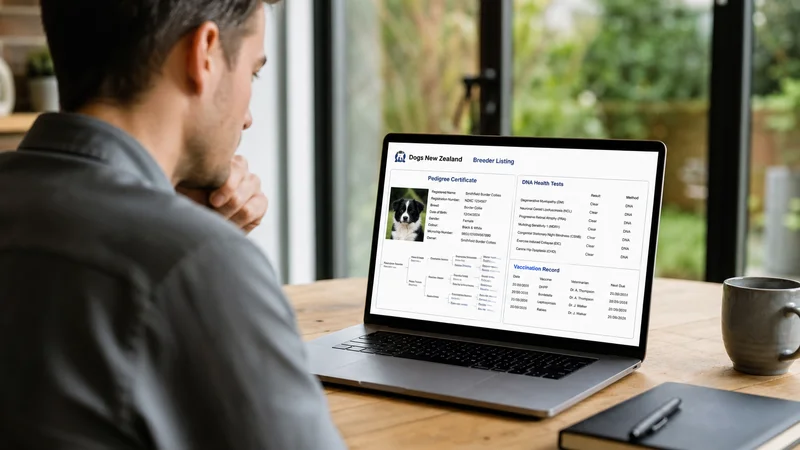
Dogs New Zealand is New Zealand’s national body for pedigree dog registration, breeding and accreditation. Its accredited breeders must complete required DNA health tests on the dogs they breed from before submitting a litter notification. Buyers can also check a breeder’s registration and a puppy’s pedigree through the Dogs New Zealand registry, according to Dogs New Zealand’s breeder information.
That gives you a practical document trail. Ask for the breeder’s registered details, the parents’ names and the relevant health-test information. Then compare those details with the organisation’s own registry. Do not rely solely on a logo, screenshot or social-media claim.
Accreditation is evidence, not a guarantee
Accreditation may indicate that the breeder has met the scheme’s requirements. Nevertheless, you still need to assess the puppy’s day-to-day environment and the breeder’s communication.
Ask:
- Which DNA tests apply to this breed?
- Were the parent dogs tested before this litter was notified?
- Can you verify the breeder and pedigree through Dogs New Zealand?
- What health issues have appeared in related dogs?
- What support will the breeder provide after collection?
A responsible breeder should discuss uncertainty without promising a perfect outcome. In addition, ask for copies of records before you pay a deposit. If the breeder says testing is “not necessary” but claims accreditation, verify that statement independently.


Pet Health Map App
Turn every worry into your pet’s health record
Download the app to save AI Care reports, build your pet’s medical profile, and keep tracking symptoms and care notes.
Android version coming soon. The web version is available now.
Puppy-farm red flags: inspect the setting, not just the advert
The strongest warning signs usually appear when a breeder avoids transparency. A professional website, attractive photographs and urgent sales language cannot show how the dogs live.
Arrange to see the puppy with its mother and inspect the area where they spend time. Observe the dogs quietly. Look for whether the breeder welcomes questions, explains routines and allows you to consider the decision without pressure. Be cautious if the meeting happens somewhere unrelated to the advertised home, or if the breeder offers several unrelated litters without a clear explanation.
Avoid treating one sign as proof of a puppy farm. Instead, use the CLEAR check:
- C — Conditions: Can you inspect the living area?
- L — Lineage: Can you verify the parents and pedigree claims?
- E — Evidence: Are health and identification records available?
- A — Answers: Does the breeder respond directly?
- R — Release: Can you leave without pressure to pay immediately?
Warning signs that deserve a pause
| Warning sign | Why it matters | Safer response |
|---|---|---|
| You cannot see the mother | You cannot assess her condition or confirm the relationship | Ask to see both together |
| Records remain vague | Claims become difficult to verify | Request copies and check details |
| The seller creates urgency | Pressure can discourage sensible checks | Delay payment until verification |
| Several answers conflict | Inconsistent information may indicate poor records | Write down questions and compare replies |
| The environment cannot be inspected | Advertisements show only selected images | Walk away if access remains restricted |
MPI explains that welfare codes contain minimum standards and recommended best practices. Therefore, a clean photograph should not outweigh what you observe in person. If you suspect an animal-welfare problem, record factual details and seek guidance from the appropriate New Zealand authority rather than confronting the seller aggressively.
Questions to ask before paying a puppy deposit
The best questions produce records, not rehearsed reassurance. Send your questions in writing, then save the replies and any documents.
Begin with the puppy’s background. Ask who owns the mother, where she lives and how often she has been bred. Ask what health testing applies to the breed and whether the parents’ results are available. If the breeder claims Dogs New Zealand accreditation, verify the claim through the organisation’s registry.
Next, ask about the sale itself. Confirm what the deposit secures, whether the terms are written and what happens if a health concern changes the arrangement. Do not assume a verbal promise will be easy to prove later. Ask which identification details you will receive and who will arrange the initial microchip record.
A practical buyer’s record
Take this checklist to a viewing:
- Breeder’s full name and contact details
- Parent dogs’ names and registration details
- DNA health-test records, where relevant
- Puppy identification information
- Written deposit and sale terms
- Feeding and routine notes
- Microchip number and database instructions
- Advice for contacting the breeder after collection
Record what you see, not what you hope to see. For example, note whether the mother is present, where the puppies are housed and which documents you actually received. A written record helps you compare breeders calmly.
If the breeder refuses to answer basic questions, do not let a limited litter or emotional attachment make the decision for you. A deposit creates financial and emotional pressure. Therefore, complete your checks before transferring money.
Microchipping and registering your new puppy
Microchipping is only the identification step. It does not, by itself, provide your current contact details.
The New Zealand Companion Animal Council and New Zealand Companion Animal Register explain that a microchip stores a unique identification number. That number must link to current owner details in a registration database, such as NZCAR, to help reunite a lost pet. Their guidance also highlights persistent confusion between microchipping, registration and council requirements.
Before collection, ask for the microchip number and the database where it is recorded. After ownership changes, confirm that your name, address, telephone number and email address are correct. Update those details whenever you move or change contact information. For the full legal requirements around this step, see our guide to dog registration and microchipping in New Zealand.
Keep identification tasks separate
| Task | What it does | Your action |
|---|---|---|
| Microchipping | Provides a unique identification number | Obtain and retain the number |
| Database registration | Links the number to your contact details | Confirm your details are current |
| Council requirements | May involve separate local obligations | Check your local council’s current rules |
Do not assume the breeder, database or council automatically completes every step for you. Ask who has done what, request confirmation and keep the paperwork with your purchase records. This small administrative check can matter months or years after the sale.

Buying a puppy in New Zealand: a safer decision process
Use a pause-and-prove approach: inspect, verify, record, then decide. This method reduces the chance that excitement will override evidence.
Start by inspecting the puppy, mother and living conditions. Next, verify breeder claims through Dogs New Zealand where relevant, and check the documents against the breeder’s answers. Then record the health information, identification number, deposit terms and promised support. Only after those steps should you decide whether the breeder deserves your money.
Remember that New Zealand law does not provide a simple national cap on breeding-dog numbers or a minimum breeding age for bitches. The Animal Welfare Act 1999 instead addresses breeding that produces characteristics likely to cause ill health or injury. Consequently, welfare assessment must remain central to your decision.
A responsible purchase does not require you to accept pressure. If records are missing, access is restricted or answers change, pause the transaction. You can contact Dogs New Zealand to verify accreditation and pedigree information, while MPI’s welfare-code information can help you understand the standards and recommended practices that apply to animal care.
Conclusion: make evidence your buying rule
Buying a puppy in New Zealand becomes safer when you treat the process as verification rather than impulse. Check the living conditions, see the mother, ask for health records and verify Dogs New Zealand claims through its own registry. Remember that accreditation supports your assessment but does not replace it.
Before paying, write down what the breeder promised and confirm the puppy’s microchip and database details. Also check your local council’s current requirements, because microchipping, database registration and council obligations are separate matters.
Use the CLEAR check, keep copies of every document and walk away from pressure or unexplained gaps. If you are considering a breeder now, make your questions list today and arrange a viewing only when the breeder agrees to transparent checks. Once your puppy is home, our guide to free and subsidised pet desexing in New Zealand can help with planning that next step.