Cattery NZ Rules: 7 Checks Before Booking
Leaving a pet in temporary accommodation involves more than comparing online reviews. You need to know whether the facility can protect your animal’s health, behaviour and welfare while you are away.
In New Zealand, boarding kennels and catteries must meet the minimum standards in MPI’s Code of Welfare: Temporary Housing of Companion Animals (2018), under the Animal Welfare Act 1999. Local council approval may also apply. Before booking, ask how the facility meets these standards.
This guide explains the legal baseline, what to ask during a visit, how to assess hygiene and isolation arrangements, and which warning signs should make you look elsewhere. It also separates national animal-welfare requirements from council matters, which can vary between districts and cities.
Why cattery NZ rules matter before you book
The bottom line is simple: a boarding facility has welfare responsibilities, not merely a business obligation to provide food and a sleeping area. MPI’s code applies to temporary housing facilities across New Zealand, including kennels, catteries, animal daycare centres and other boarding establishments.
The code aims to inform owners and people in charge about the standards they must achieve under the Animal Welfare Act 1999. Therefore, a polished website or high review score does not replace practical questions about daily care.
A good facility should be able to explain:
- Who checks animals during the day and overnight, if applicable.
- How staff recognise illness, injury, fear and distress.
- How the facility provides food, water, shelter and suitable housing.
- How staff manage animals with different temperaments or needs.
- What happens during an emergency or unexpected closure.
The code covers 12 areas, including responsibilities and competency, animal handling, food and water, health, behavioural needs, housing, facility management, transportation, euthanasia and quality assurance. It also covers significant surgical procedures and sale or rehoming.
Consequently, use the code as a conversation starter. You do not need to memorise every section. You do need enough information to judge whether the operator understands its obligations.
Cattery NZ rules: the legal baseline
The legal baseline comes from the Animal Welfare Act 1999 and MPI’s temporary-housing code. The code’s minimum standards are not optional guidance for people in charge of companion animals in these facilities.
MPI’s Code of Welfare: Temporary Housing of Companion Animals (2018) applies to all companion animals in temporary housing. That wording includes cats and dogs, so it covers both catteries and boarding kennels.
However, the code does not tell you that every facility will offer the same service. One cattery may specialise in quiet indoor accommodation, while another may combine boarding with daycare. The operator still needs to meet the relevant minimum standards for the animals in its care.
Ask the operator:
- Which parts of the MPI code guide your daily procedures?
- How do you record feeding, medication and health observations?
- What happens if an animal becomes unwell?
- How do you manage animals that show fear, aggression or separation distress?
- How do you contact the owner during an emergency?
A confident, specific answer provides useful evidence. By contrast, a vague response such as “we have always done it this way” gives you little information about the facility’s welfare systems.
What the code covers
The code’s scope is broad. It addresses routine care as well as less common events, such as transportation, rehoming and euthanasia. That breadth matters because a boarding stay can change quickly when an animal becomes ill or distressed.
The code also recognises responsibilities, competency and animal handling. Therefore, ask who will handle your pet and what information staff receive about individual behaviour.


Pet Health Map App
Turn every worry into your pet’s health record
Download the app to save AI Care reports, build your pet’s medical profile, and keep tracking symptoms and care notes.
Android version coming soon. The web version is available now.
Council approval can differ by location
Council requirements must be checked locally because district and city councils may apply different rules through their District Plans or local processes. Do not assume that one national approval requirement applies to every boarding kennel or cattery.
The MPI source confirms the animal-welfare framework, but it does not establish one nationwide rule for resource consent or registration. Therefore, contact the council responsible for the facility’s address before relying on claims about approval.
Ask the operator:
- Which council covers this property?
- Does the council require any consent or registration for this activity?
- Can you provide the relevant approval details?
- Are there restrictions affecting operating hours, noise or the number of animals?
You should also contact the council directly if the operator cannot answer clearly. Requirements can depend on the property, the activity and the local District Plan. In addition, a facility may have changed its services since it opened.
Do not treat a council query as proof that the business has done something wrong. It is simply part of sensible due diligence. The practical aim is to confirm that the facility has considered both animal welfare and local requirements.
| Question | Why it matters |
|---|---|
| Does the MPI code apply? | It applies to temporary housing facilities, including catteries and kennels. |
| Which council covers the property? | Local requirements can differ between districts and cities. |
| Can the operator explain its procedures? | Clear answers show how standards work in daily care. |
What to inspect before boarding your pet
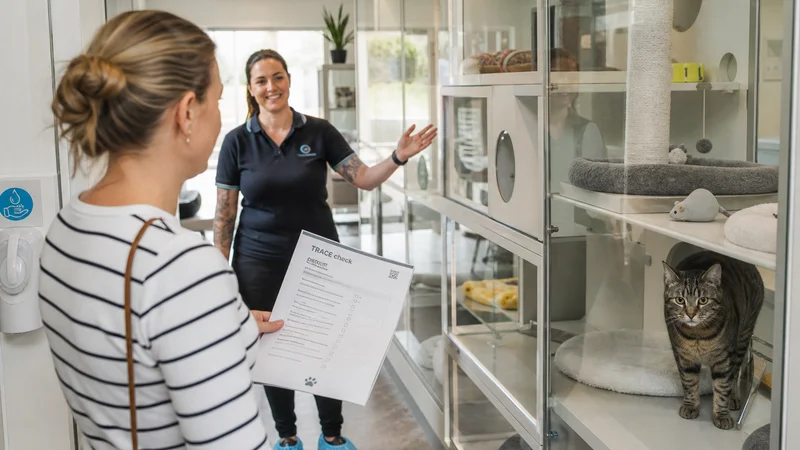
The best assessment combines questions with a careful look at the facility. Ask to see the areas where your pet will stay, if visits are allowed. Focus on welfare systems rather than decoration.
Use this TRACE check:
- T — Temperament: How does staff assess behaviour and stress?
- R — Routine: How are feeding, medication, exercise and observations recorded?
- A — Accommodation: Does the housing appear suitable for the animals using it?
- C — Contamination control: How does the facility clean areas and manage unwell animals?
- E — Emergency planning: What happens if an animal needs urgent veterinary attention?
Observe whether staff handle animals calmly and whether they can answer without guessing. Also check whether the facility appears overcrowded, poorly maintained or difficult to ventilate.
Ask about admission procedures. A responsible operator should explain what information it needs about your pet’s health, medication, diet and behaviour. You should disclose previous illness, anxiety, escape attempts, biting, toileting problems and triggers. Withholding these details can make care less safe.
Before arrival, prepare a written care sheet containing:
- Your veterinarian’s contact details.
- Medication names, doses and administration times.
- Feeding quantities and normal meal times.
- Emergency contacts and permission instructions.
- Behavioural triggers, hiding preferences and handling limits.
This practical preparation helps staff distinguish normal behaviour from a health or stress change.
Health, hygiene and behavioural needs
Health and behaviour deserve equal attention because a pet can appear physically well while struggling with fear or environmental change. MPI’s code specifically covers health, behavioural needs, housing, food and water.
Ask whether the facility carries out a health assessment when animals arrive. Also ask what staff do if they notice vomiting, diarrhoea, coughing, lethargy, injury or a sudden behaviour change. The operator should explain its process without promising that illness can never occur.
Isolation management deserves a direct question. Ask where a potentially unwell animal would stay and how staff reduce contact with other animals. Do not assume that “separate” means the facility has a complete clinical isolation area; ask the operator to describe the arrangement.
Hygiene questions should include:
- How often are sleeping and toileting areas cleaned?
- How do staff deal with soiled bedding?
- How are food and water containers cleaned?
- What happens after an animal leaves?
- How does the facility manage suspected infectious illness?
Behavioural needs also influence the booking decision. A cat that hides, stops eating or reacts to handling may need a quieter arrangement. Similarly, a dog that cannot cope with group interaction may require individual care.
Share your pet’s normal routine and stress signals. This gives staff a baseline and helps them identify meaningful changes.
Red flags before you pay a deposit
The strongest warning signs involve secrecy, poor conditions or an inability to explain basic care. One awkward answer does not automatically prove poor welfare, but a pattern should make you pause.
Treat these signs seriously:
- The operator refuses reasonable questions about welfare procedures.
- Staff cannot explain what happens when an animal becomes ill.
- The facility appears overcrowded, unclean or badly maintained.
- The operator dismisses your pet’s known medical or behavioural needs.
- The business pressures you to book before you can view the accommodation.
- Staff give conflicting answers about feeding, supervision or emergencies.
Conversely, a suitable facility should welcome clear information about your pet. It should also explain its limits. For example, an operator may tell you that it cannot safely accommodate a pet requiring care beyond its staff or facilities.
Do not rely on photographs alone. Visit at a normal operating time where possible, because online images may not show noise, odour, congestion or staff availability. In addition, ask whether the exact accommodation shown will be available for your booking.
If something feels unclear, delay the decision. Compare another facility and ask the same questions. A lower price does not compensate for uncertainty about care, while a higher price does not guarantee quality.
Make a documented booking decision
The safest booking decision comes from written information, a facility visit and a clear emergency plan. Before you confirm, record the answers that matter to your pet rather than relying on memory.
Use this final checklist:
- Facility address and council contact.
- Admission health and vaccination requirements, as stated by the operator.
- Accommodation type and daily routine.
- Feeding instructions and medication arrangements.
- Behavioural information supplied by you.
- Illness, injury and veterinary-contact procedure.
- Emergency contact details.
- Collection time and cancellation terms.
- The name of the person responsible for your pet’s care.
Ask the operator to confirm important arrangements in writing. Keep copies of vaccination records, prescriptions and your care sheet. Also provide a current photograph and your preferred emergency contact.
Remember that MPI’s code sets minimum welfare standards; it does not guarantee that every facility suits every animal. A nervous cat may need a quiet cattery, while a social dog may require a different boarding arrangement. Match the facility to the pet, not only to its location or price.
Conclusion: use cattery NZ rules as your booking filter
The key cattery NZ rules come from MPI’s Code of Welfare: Temporary Housing of Companion Animals (2018) and the Animal Welfare Act 1999. Local council requirements may also apply, but you must confirm those directly with the relevant district or city council.
Before booking, use the TRACE check: assess temperament, routine, accommodation, contamination control and emergency planning. Then visit the facility, ask how staff handle illness and stress, and record the answers in writing.
If the operator avoids reasonable questions or the premises look overcrowded or unclean, keep looking. Contact shortlisted facilities today and ask for their care procedures, admission requirements and council details before you pay a deposit.