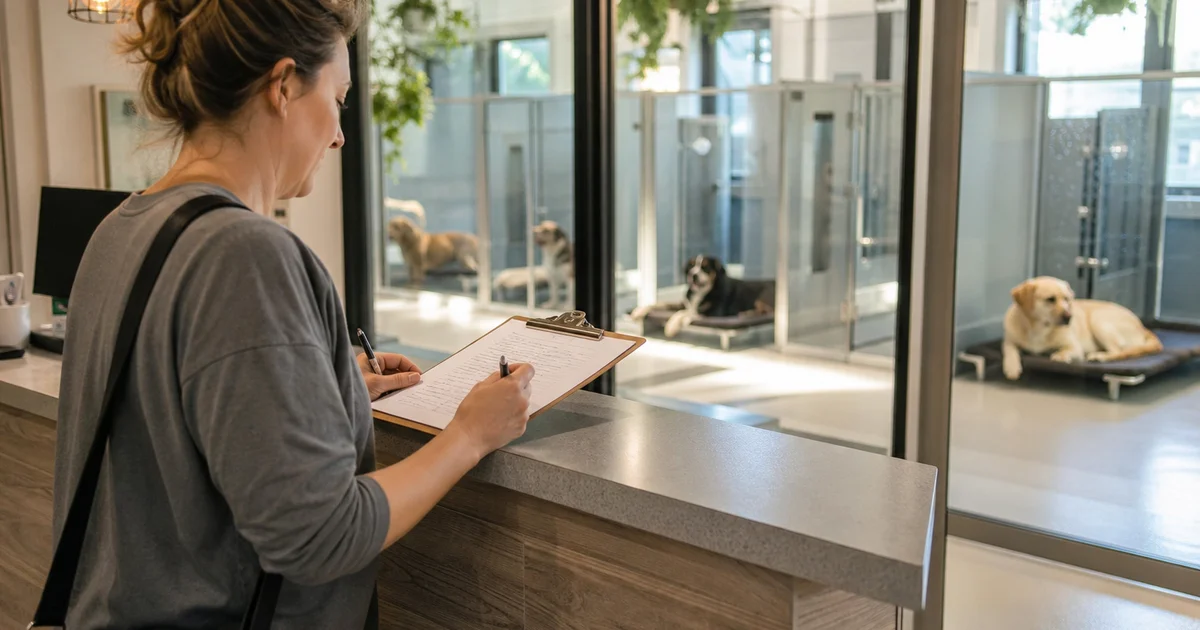
Pet Boarding Licence Canada: 6 Checks Before Booking
Leaving a dog or cat with a boarding business can feel risky, especially when licensing rules differ between Canadian communities. A polished website does not prove compliance. Before choosing a kennel, owners should verify the local requirements, ask for current licence details and inspect how the business manages animals.
There is no single Canada-wide pet boarding licence. Requirements vary by province and municipality, so check the rules where the kennel operates. Ask the operator to show its current licence, confirm any inspection process and verify whether extra approvals apply to the premises, home-based operation or number of animals boarded.
This guide solves three practical problems:
- understanding why licensing differs across Canada;
- seeing how New Brunswick, Ontario and Calgary approach kennel oversight; and
- using a call-and-visit checklist before making a booking.
What a pet boarding licence means in Canada
A pet boarding licence usually means the operator has met a local or provincial licensing requirement. It does not automatically prove that the facility suits every animal or that its day-to-day care meets an owner’s expectations. Therefore, treat licensing as one verification step rather than the whole choosing-a-kennel decision.
The rules can apply to different activities, including boarding, doggie daycare, breeding, selling, training or housing animals. The exact trigger may depend on the number and type of animals, the property’s zoning and whether the business operates from a home or commercial premises.
When calling a boarding kennel, ask these focused questions:
- What licence or business approval covers your boarding service?
- Which authority issued it, and when does it expire?
- Can I see the current document or verify it through the issuing authority?
- Does the licence cover this address and the number of animals you board?
- Are any land use, fire or home-based approvals also required?
A responsible operator should answer clearly without becoming defensive. However, owners should contact the municipality or provincial authority directly if the answer remains vague. Licensing names and thresholds can change, so an online advert or an old certificate may not reflect the current position.
Why pet boarding licence rules vary by location
Canada uses a patchwork of provincial and municipal requirements rather than one national kennel licence. Consequently, a rule that applies in one Ontario township may not apply in another municipality, while a provincial scheme may operate in a different way in New Brunswick.
Municipalities may regulate animal businesses through kennel licences, business licences, animal-control bylaws or premises approvals. They may also set their own renewal dates, inspection arrangements and animal-number thresholds. In addition, a business can face separate land use or fire approval requirements.
The supplied government sources demonstrate this variation:
| Location | What the official source says |
|---|---|
| New Brunswick | Kennels require a C$250 annual licence under the Pet Establishment Regulation |
| Township of King, Ontario | Kennels and doggie daycares need an annual licence, renewed by 30 April |
| Township of Guelph/Eramosa, Ontario | A threshold of 3 dogs or 4 cats can trigger a kennel licence |
| Calgary, Alberta | Animal-care businesses need a municipal business licence, with possible extra approvals |
These examples are not a substitute for checking the operator’s exact address. A family researching a kennel near a municipal boundary should confirm which council regulates the premises. In other words, the town named in the business’s marketing may not be the authority that issued its licence.



Pet Health Map App
Turn every worry into your pet’s health record
Download the app to save AI Care reports, build your pet’s medical profile, and keep tracking symptoms and care notes.
Android version coming soon. The web version is available now.
New Brunswick’s provincial pet establishment rules
In New Brunswick, the provincial Pet Establishment Regulation provides a clearer province-wide example. The Government of New Brunswick states that kennels and pet retail stores must hold a licence costing C$250 per year. Animal shelters have a separate C$100 annual fee. The NB SPCA oversees and enforces the regulation and sets animal-care standards. (Government of New Brunswick, accessed 2026.)
That distinction matters when an owner compares a New Brunswick kennel with a business elsewhere in Canada. The C$250 figure belongs to this New Brunswick regulatory scheme. It should not become a presumed Canadian fee.
Owners should ask a New Brunswick operator whether the licence covers the specific boarding premises and current operation. They can also ask how the business handles:
- individual feeding instructions;
- medication and veterinary contact details;
- separation between unfamiliar animals;
- exercise and toileting routines; and
- emergency transport or after-hours concerns.
Those questions assess practical care rather than simply document possession. A licence can help establish that the operator falls within a regulatory framework, yet owners still need to judge cleanliness, supervision and suitability for their pet.
If the operator cannot explain which authority oversees the business, contact the relevant provincial service before paying a deposit. Keep the operator’s legal or trading name, address and licence details available when making that enquiry.
Ontario examples: thresholds and annual inspections
Ontario shows why owners must check the municipality, not just the province. In the Township of King, kennel and doggie daycare operators need an annual licence under By-law 2012-175, amended by By-law 2025-009. The licence renews by 30 April, and the township’s contracted animal services conduct annual inspections. (Township of King, Ontario, accessed 2026.)
The Township of Guelph/Eramosa uses a different threshold. Under By-law 04/2017, a kennel licence is required when an operator houses, boards, breeds, trains or sells at least 3 dogs or 4 cats. A boarding kennel licence applies specifically when more than 3 dogs are boarded together in an open setting without barriers. Licences last 12 months, and municipal law enforcement officers inspect throughout the year. (Township of Guelph/Eramosa, Ontario, accessed 2026.)
These rules create an important practical check. Ask the operator:
- Which township or municipality issued the licence?
- What animal-number threshold applies to this premises?
- Does the licence cover boarding, daycare or both?
- When did the latest inspection or renewal occur?
Do not assume that a small home boarding service avoids licensing. The relevant threshold may depend on the number of animals or the activity, not on the business’s size or advertising style.
Calgary business licensing and premises approval
Calgary takes a business-licensing approach for animal-care operators. The City of Calgary states that a business which cares for, boards, breeds or sells animals requires a municipal business licence. Depending on the location, the operator may also need land use approval and Fire Prevention Bureau approval. Home-based animal boarding has separate provisions from commercial premises. (City of Calgary, accessed 2026.)
Therefore, a Calgary operator’s answer should cover more than “yes, we are registered”. Ask which business licence applies and whether the premises has the required land use approval. For a home-based service, ask whether the operator is relying on provisions specifically covering home-based animal boarding.
Owners should record the address rather than relying only on a business name. This helps them check the correct municipal information, particularly when a business serves several neighbourhoods or collects pets from a different location.
A sensible call might sound like this:
“Could you tell me which Calgary business licence covers the boarding address, and whether any land use or fire approvals apply?”
The question is direct without accusing the operator of wrongdoing. If staff cannot identify the licensing category or premises address, pause before booking. Also, do not treat a business licence as a guarantee of individualised care, secure handling or veterinary suitability.
The pre-booking checklist and warning signs
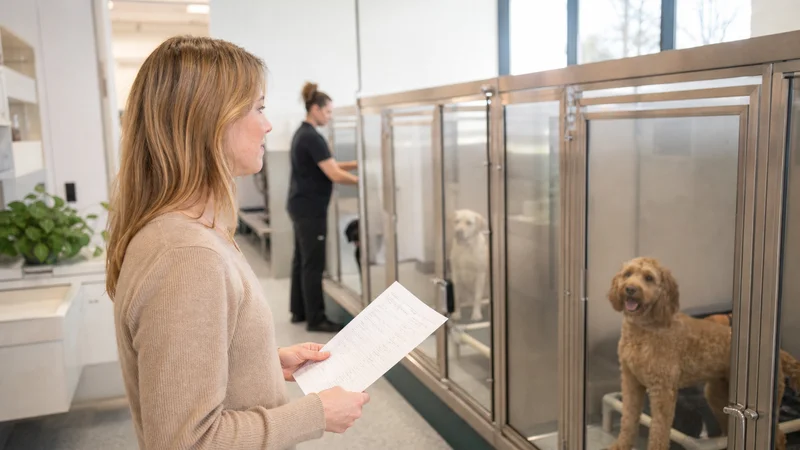
The safest choosing-a-kennel process combines document checks with an in-person visit. Before paying, ask the operator to confirm the licence information and observe the areas where pets will sleep, exercise and interact.
Use this checklist during the call or visit:
| Check | What to record |
|---|---|
| Licence | Issuing authority, licence type and expiry date |
| Premises | Exact boarding address and whether it matches the licence |
| Animal groups | How unfamiliar dogs or cats are separated |
| Daily care | Feeding, medication, exercise and toileting arrangements |
| Emergencies | Contact person, veterinary plan and owner notification process |
| Your pet’s needs | Required records, food, medication and behaviour information |
Prepare a one-page care sheet before arrival. Include feeding quantities, medication times, allergies, escape risks, handling triggers, your vet’s contact details and an emergency contact. Bring enough familiar food and label every item. Moreover, record your pet’s normal appetite, stool pattern and behaviour, so the carer can spot a meaningful change.
Warning signs include:
- refusal to identify the licensing authority;
- a licence that names a different address or activity;
- pressure to pay before answering basic questions;
- overcrowded or poorly secured areas during a visit; and
- no clear plan for medication or urgent veterinary care.
None of these observations alone proves a legal breach. However, they justify pausing and verifying the business with the relevant municipality or province. Fees and approval requirements vary, so call the issuing authority rather than relying on an online claim.
Conclusion: verify before choosing a kennel
A pet boarding licence can provide useful evidence that an operator has entered the relevant regulatory system. However, Canada has no single national licence, and requirements differ between provincial schemes and municipal bylaws. New Brunswick, Ontario townships and Calgary illustrate why owners must verify the exact boarding address and local authority.
Before booking, ask to see the current licence, record the expiry date and confirm whether extra premises approvals apply. Then visit the facility, discuss your pet’s routine and request a clear emergency plan. If the operator avoids straightforward questions, choose a different option while checking the concern with the local authority.
Use the same checklist every time you compare providers. That simple habit makes choosing a kennel more methodical and helps you separate reassuring paperwork from genuinely prepared day-to-day care.