
If you are asking whether breed-specific legislation in Canada still applies, the answer is yes in some locations. Ontario retains province-wide pit bull restrictions, and Winnipeg prohibits bringing pit bulls into the city. Calgary takes a different approach, using responsible-ownership rules and education rather than breed bans. Always check the current local rule before travelling or moving.
The practical difficulty lies in the details. A rule may apply across a province, within one municipality, or only to a specific activity such as bringing a dog into the city. Meanwhile, Calgary demonstrates that Canadian cities can regulate canine behaviour without using breed-specific legislation.
Where breed-specific legislation in Canada still applies
The clearest examples in the supplied official sources are Ontario and Winnipeg. However, they do not operate in exactly the same way. Ontario's restriction comes from provincial legislation, while Winnipeg's rule comes from the city's prohibited-animals policy.
The Government of Ontario amended its Dog Owners' Liability Act through O. Reg. 434/05: Pit Bull Controls. The regulation was filed on 25 July 2005 and introduced province-wide restrictions on pit bulls. (Government of Ontario, 2005) Current Ontario legislation still refers to a "restricted pit bull" under the Dog Owners' Liability Act. (Government of Ontario, 2026)
Winnipeg's rule is more direct for visitors. The City of Winnipeg Animal Services Agency states that pit bulls may not be brought into the city, including by visitors. (City of Winnipeg, 2026)
| Location | Approach identified in the official source | Practical meaning |
|---|---|---|
| Ontario | Province-wide pit bull restrictions | Check provincial legislation before relocating or travelling |
| Winnipeg | Pit bulls may not be brought into the city | Visitors must not bring a pit bull into Winnipeg |
| Calgary | No breed-specific legislation | Behaviour, nuisance concerns and owner responsibilities matter instead |
Therefore, do not treat "Canada" as one legal zone. The relevant answer depends on the province and municipality involved.
Ontario: the province-wide pit bull restriction
Ontario remains the most significant province-wide example. The legal framework comes from the Dog Owners' Liability Act and its pit bull controls regulation, rather than from an individual city choosing its own breed ban.
The Ontario Gazette records the filing of O. Reg. 434/05: Pit Bull Controls on 25 July 2005. That regulation restricted pit bulls across Ontario. (Government of Ontario, 2005) In addition, current Ontario e-Laws material continues to use the term "restricted pit bull" in connection with the Dog Owners' Liability Act. (Government of Ontario, 2026)
That combination matters for owners because provincial legislation can affect travel plans beyond a single municipal boundary. A person moving between Ontario communities should not assume that a local council's website provides the complete answer.
Before making arrangements, prepare a short document pack:
- the dog's adoption, purchase or veterinary records;
- vaccination and microchip details;
- any existing licence or registration information;
- the exact address where the dog will live; and
- the route and overnight stops for a road journey.
However, do not try to settle a legal classification from photographs or informal online comments. Ask the relevant authority for written guidance, and keep the reply with your records. The current rule, the dog's documentation and the proposed destination should all match before you travel.



Pet Health Map App
Turn every worry into your pet’s health record
Download the app to save AI Care reports, build your pet’s medical profile, and keep tracking symptoms and care notes.
Android version coming soon. The web version is available now.
Winnipeg: a city with a prohibited-animal rule
Winnipeg applies a separate municipal restriction. The City of Winnipeg Animal Services Agency states that pit bulls may not be brought into the city, and it specifically includes visitors in that instruction. (City of Winnipeg, 2026)
That wording creates an important travel checkpoint. A visitor should not assume that a short stay, a hotel booking or a temporary visit avoids the rule. The safest approach involves checking the city's current prohibited-animals information before entering Winnipeg.
Use this simple STOP check:
- S — See the official wording: read the City of Winnipeg Animal Services page.
- T — Test your travel plan: identify whether your route enters Winnipeg's city limits.
- O — Obtain written clarification: contact the relevant city service if your dog's status is unclear.
- P — Preserve the answer: save the page, email or reference number with your travel documents.
This process also helps separate two questions that owners often combine: "Can my dog live in the place?" and "Can I bring my dog into the place?" Winnipeg's published statement addresses bringing a pit bull into the city. Therefore, a planned visit requires attention even if the dog normally lives elsewhere.
Avoid relying on social media, old forum posts or advice from a previous trip. Municipal policies can sit separately from provincial rules, so the official city source should anchor your decision.
Calgary's alternative: responsible ownership without breed bans
Calgary uses a different model. The City of Calgary states that its Responsible Pet Ownership approach uses no breed-specific legislation. Instead, the city requires mandatory education or training programmes for owners of pets deemed nuisances. (City of Calgary, 2026)
This is a behaviour-led framework rather than a breed-led restriction. In practical terms, the owner's responsibilities and the animal's conduct become central concerns. That distinction can affect how you prepare for a move, particularly if you are comparing Calgary with Ontario or Winnipeg.
Calgary's updated Responsible Pet Ownership Bylaw took effect on 1 January 2022. The city also limits each household to six cats and six dogs. (City of Calgary, 2022)
| Question to ask | Why it matters in Calgary |
|---|---|
| Does the household already have pets? | The six-cat and six-dog household limit may affect planning |
| Has the city identified a pet as a nuisance? | Mandatory education or training may apply |
| Have you checked the current bylaw page? | The official city source provides the latest local guidance |
| Can you document your ownership plan? | Written records make discussions with authorities clearer |
Consequently, "no breed ban" does not mean "no pet rules". Owners still need to check household limits, nuisance-related requirements and any current bylaw instructions before moving.
How to check breed-specific legislation in your area
The safest answer to a local legal question comes from the authority responsible for that rule. Start with the provincial government if your destination is in Ontario. Start with the municipal animal-services or bylaw department when the issue concerns a city such as Winnipeg or Calgary.
Use this five-part MATCH check:
- M — Map the journey: list every province and municipality where the dog will stay.
- A — Authority: identify the official government or city page for each location.
- T — Terms: search the exact terms used by the authority, such as "prohibited animals" or "restricted pit bull".
- C — Confirm: contact the authority when the published wording does not answer your situation.
- H — Hold records: save links, emails and dates in one travel folder.
The MATCH check prevents a common mistake: checking only the destination city while overlooking a stop en route. It also helps distinguish a provincial statute from a municipal rule.
Record these details before you commit to travel:
| Record | What to write down |
|---|---|
| Destination | Province, city and exact accommodation |
| Rule source | Official page or legislation title |
| Date checked | The day you verified the information |
| Contact trail | Department, phone number or email |
| Decision | Permitted, prohibited or clarification required |
Because this is a legal and animal-welfare issue, do not guess when the source is unclear. Instead, pause the journey and request current guidance.
Moving or travelling with a dog: practical preparation
Breed-specific legislation in Canada can affect a journey before the dog reaches its destination. Build the legal check into your travel preparation rather than treating it as a last-minute packing task.
Begin with the route. Mark every location where the dog may enter, leave the vehicle or stay overnight. Then check the official rule for each location. A route through a city with a prohibition can create a problem even when the final destination follows a different model.
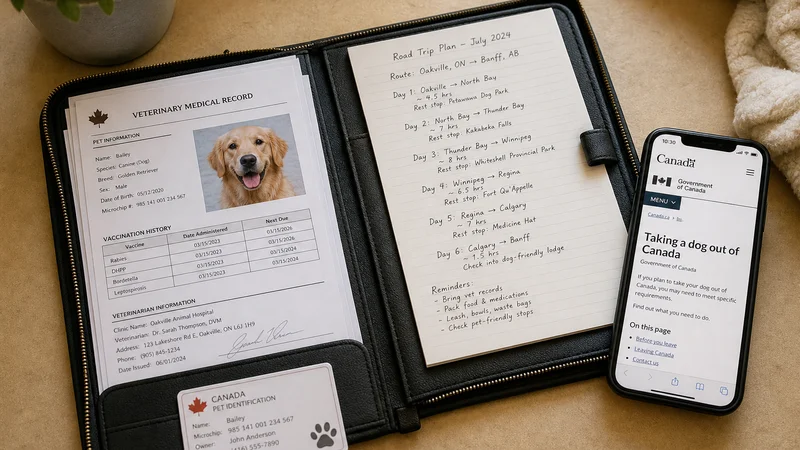
Prepare a compact travel folder containing:
- ownership and veterinary records;
- identification and contact details;
- accommodation information;
- screenshots or printouts of official guidance;
- written replies from authorities; and
- a backup contact for your veterinary practice.
Do not assume that a dog's informal breed label answers a legal question. The Ontario sources use the statutory term "restricted pit bull", while Winnipeg's official page uses "Pit Bulls". Therefore, ask the responsible authority how it applies the wording to your circumstances.
Finally, check again close to departure. The Government of Ontario source confirms the current statutory reference, while city policies provide local instructions. A fresh review helps you avoid relying on an old booking note or an outdated forum answer.
Conclusion: make the official-source check before you move
Breed-specific legislation in Canada is not uniform. Ontario retains province-wide pit bull restrictions, Winnipeg prohibits bringing pit bulls into the city, and Calgary uses a no-breed-ban responsible-ownership model. These differences make location-by-location checking essential.
Use the MATCH check: map every stop, identify the responsible authority, search its exact wording, confirm uncertainty and keep written records. Gather your dog's documents before contacting officials, then save their response with your travel plans.
If you are moving or travelling soon, check the official provincial and municipal sources today. When the wording does not clearly cover your dog or route, contact the authority before booking transport or accommodation.