
Puppy Farming Laws Australia: NSW Rules in 5 Steps
Buying or breeding a puppy in Australia can involve legal duties, even when a litter was accidental. NSW introduced important breeder identification changes on 1 December 2025, but the rules do not apply identically across every state or territory. Buyers should therefore verify the breeder, the puppy’s microchip details and the relevant local requirements before paying.
Puppy farming laws Australia-wide are not one single national scheme. In NSW, anyone who breeds a dog must follow breeder obligations, including identification and advertising requirements. From 1 December 2025, NSW breeder identification numbers use separate dog and cat eligibility classes. Buyers should check the breeder’s details before committing.
This guide solves three common problems:
- understanding what people mean by “puppy farm”;
- separating NSW’s current rules from broader Australian assumptions; and
- checking a breeder before money changes hands.
What puppy farming laws Australia buyers need to understand
The bottom line is that “puppy farm” describes a welfare concern, not a single national legal label. It generally refers to high-volume or poorly managed breeding where the health, socialisation and living conditions of breeding dogs and puppies receive inadequate attention. However, a buyer should assess evidence rather than rely on the label alone.
NSW obligations apply to everyone who breeds dogs, including people with accidental litters. Gilgandra Shire Council says the rules effective from 1 December 2025 aim to address puppy farming, improve welfare for mothers and puppies, and increase transparency around breeding (Gilgandra Shire Council, 2026).
That means a small home breeder cannot assume the rules only affect commercial operations. Equally, a registered or recognised breeder still needs to provide clear information and care for the animals appropriately.
Look for practical signs of responsible breeding:
- the mother and puppies appear clean, alert and appropriately cared for;
- the breeder explains the puppy’s history without avoiding questions;
- the breeder provides identifying information before sale or transfer; and
- the advertisement contains the details required under the applicable rules.
By contrast, repeated litters, unclear ownership, pressure to pay quickly or reluctance to show the puppy’s environment should prompt caution. These warning signs do not prove an offence, but they justify pausing and making further checks.
NSW puppy farming laws from 1 December 2025
The key change is that NSW breeder identification numbers now include two eligibility classes: dog breeder and cat breeder. The change took effect on 1 December 2025 and applies to the breeder identification system rather than creating a new national Australian licence (NSW Office of Local Government, 2026).
The NSW Office of Local Government also states that breeder identification numbers issued before that date are updated, rather than cancelled and reissued. Numbers issued after the change have both classes activated. Therefore, an older-looking number is not automatically invalid.
NSW breeders also face wider obligations, including:
| Requirement | What it means for a buyer |
|---|---|
| Breeder identification number | Ask for the breeder’s relevant identification details |
| Microchipping | Confirm the puppy has a microchip before sale or transfer |
| Advertising requirements | Check that the advert provides the required identifying information |
| Breeding limits | Ask sensible questions about the mother’s breeding history |
The same NSW source confirms that all cats and dogs must have a microchip number before they are sold or given away. Consequently, a breeder who wants to transfer an unchipped puppy should not be treated as meeting the basic requirement.
The source also identifies lifetime breeding limits and strengthened advertising requirements. However, the precise limit and every advertising field should be checked on the current NSW government page, rather than guessed from an advert or social media discussion.


Pet Health Map App
Turn every worry into your pet’s health record
Download the app to save AI Care reports, build your pet’s medical profile, and keep tracking symptoms and care notes.
Android version coming soon. The web version is available now.
How to become a recognised breeder in NSW
The practical distinction is that a recognised breeder is connected with a recognised breeders’ organisation. Recognition is not something a breeder can simply claim without the relevant organisational link.
The NSW Office of Local Government says a person must be a member of a recognised breeders’ organisation to qualify as a recognised breeder (NSW Office of Local Government, 2026). It also explains that a group must apply to the Deputy Secretary of the Office of Local Government for approval to become a recognised breeder organisation.
This creates two separate questions for buyers:
- Does the breeder provide a breeder identification number and meet NSW breeding obligations?
- If the breeder claims recognition, which recognised organisation do they belong to?
Those questions are related, but they are not interchangeable. Membership claims should be verifiable, and a breeder should answer without hostility or evasiveness.
For breeders, keep a clear record of:
- your breeder identification details;
- the organisation connected with any recognition claim;
- each litter and the relevant parent animals;
- microchip information before transfer; and
- the wording and date of each advertisement.
Record-keeping helps prevent mistakes, particularly when a household has more than one breeding animal. It also gives a buyer a clearer trail when checking information.
The first-timer’s common mistake is to treat a pedigree, social media following or polished website as proof of compliance. Those features may show effort, but they do not replace the NSW identification and microchipping obligations.
How buyers can check a puppy before paying
The safest approach is the TRACE check: Transfer details, Record the breeder’s number, Ask about the mother, Check the advert, and Evaluate pressure. This named five-step check helps buyers focus on evidence rather than emotion.
| TRACE step | Action before paying a deposit |
|---|---|
| Transfer details | Confirm the puppy’s microchip number will be available before sale or transfer |
| Record | Save the breeder’s identification details and the original advert |
| Ask | Request clear information about the mother and litter |
| Check | Compare the advert with the information supplied directly |
| Evaluate | Walk away from rushed payment demands or unexplained inconsistencies |
The NSW Office of Local Government confirms the microchip requirement, so ask when and how the puppy’s number will be recorded. Also save screenshots because online adverts can change after a deposit is paid.
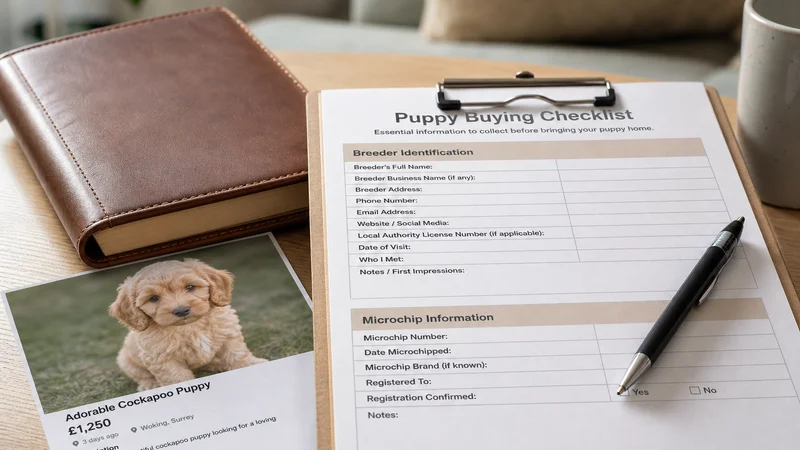
Prepare these questions before the visit:
- How many litters has the mother had?
- Can I see the mother with the puppies?
- What breeder identification details apply to this litter?
- What information will I receive at transfer?
- Why does the advert contain the details it does?
Do not send money merely because a breeder says another buyer is waiting. Instead, request written information and take time to compare it. If the breeder refuses basic questions, contact the relevant NSW authority or council for current guidance before proceeding.
A deposit is difficult to assess in isolation. Therefore, focus on traceability, animal welfare and whether the breeder’s information remains consistent from advert to conversation.
How other Australian states are tackling puppy farming
The important point is that NSW rules should not be presented as Australia’s single puppy farming law. Each state and territory can set its own requirements for breeding, registration, identification, advertising and animal welfare. This article’s verified sources establish the NSW position, not a complete national comparison.
A buyer outside NSW should therefore check the official requirements for the state or territory where the breeder operates. Do not assume that a NSW breeder identification number, recognised breeder status or advertising format applies elsewhere.
Use this comparison framework when researching another jurisdiction:
- Who regulates breeding? Identify the responsible state or territory authority.
- What identifies the breeder? Check whether a registration or identification number applies.
- What identifies the puppy? Confirm microchipping and transfer requirements.
- What must an advert show? Look for official advertising rules.
- What welfare limits apply? Check any current breeding or litter restrictions.
This approach avoids a common error: copying advice from another state and treating it as local law. It also protects buyers who purchase across borders or travel to collect a puppy.
For current NSW information, use the NSW Office of Local Government’s breeder guidance. If the breeder operates elsewhere, verify the relevant local rules directly before paying. Fees, forms, deadlines and enforcement processes can change, so this article does not guess them.
Conclusion: use evidence, not labels
The phrase “puppy farm” can help describe a welfare concern, but it cannot replace proper checks. Under NSW’s current framework, anyone breeding dogs must follow the relevant obligations, including breeder identification, microchipping and advertising requirements. From 1 December 2025, NSW breeder identification numbers use dog and cat eligibility classes.
Before paying, apply the TRACE check: record the breeder’s details, confirm the puppy’s microchip information, ask about the mother, save the advert and resist pressure. If the breeder cannot provide clear answers, pause the purchase.
Puppy farming laws Australia buyers rely on can differ between jurisdictions. Check the current official requirements for the breeder’s location, and contact the relevant authority or council when the information does not add up.