Boarding Kennel Australia Rules: 7 Checks Before Booking
Leaving a dog or cat in someone else’s care can feel risky, especially when a polished website tells you little about daily welfare standards. A responsible boarding business should welcome practical questions about approval, housing, vaccination, supervision and emergency care.
In Australia, boarding kennels and catteries must follow requirements set by the relevant state or territory and local council. In NSW, operators must comply with a specific animal-welfare code covering housing, hygiene, health care, diet and exercise. Rules differ elsewhere, so confirm current approval before booking.
This guide explains how to interpret boarding kennel Australia rules, compare facilities beyond appearance and prepare a short pre-booking check. It also separates requirements that apply in a particular jurisdiction from sensible questions every pet owner should ask.
Why boarding kennel Australia rules matter
The bottom line is simple: council approval and animal-welfare compliance provide a stronger safety signal than attractive photos or enthusiastic reviews.
A boarding establishment manages unfamiliar animals in a confined environment. That creates practical risks involving disease control, escape prevention, stress, feeding errors and delayed veterinary attention. Therefore, owners should assess the operator’s systems rather than judge the facility solely by its reception area.
The NSW Animal Welfare Code of Practice No. 5 applies to people intending to operate dog or cat boarding establishments in NSW. According to the Australian Business Licence and Information Service (business.gov.au, 2026), the code covers:
- Housing and accommodation
- Hygiene and cleaning
- Health care
- Diet and feeding
- Exercise
- Animal transportation
- Disposal of animals
- The manager’s responsibilities
The legal basis listed by business.gov.au includes the Prevention of Cruelty to Animals Act 1979 (NSW) and the Prevention of Cruelty to Animals Regulation 2025 (NSW). However, that NSW framework should not be treated as one national licence rule.
In other states and territories, the responsible department, council process and approval category may differ. Therefore, use the NSW code as a useful benchmark for questions, not as proof that every Australian facility follows identical wording.
What the NSW animal boarding code covers
The bottom line is that a compliant facility needs more than kennels, runs or cat rooms. It needs a managed system for daily care, cleanliness and animal welfare.
Housing, hygiene and exercise
Ask how staff separate dogs and cats, manage incompatible animals and clean occupied areas. A good answer should explain the routine rather than rely on a vague statement that the premises are “regularly cleaned”.
You can also ask how the facility provides exercise and enrichment. The exact arrangement may depend on the establishment, the animal’s needs and the applicable local requirements. Nevertheless, staff should explain what happens each day, including how they handle animals that cannot safely mix.
Health care, diet and transport
Before booking, provide written feeding instructions, medication details and relevant behaviour information. Record the food brand, portion size, feeding times and any food sensitivities. This reduces the chance of a rushed handover causing confusion.
Ask how staff manage illness, injury or a missed meal. Also check how they transport animals if transport forms part of the service. The NSW code specifically includes health care, diet and animal transportation among its covered standards, according to business.gov.au (2026).
Management responsibility
A named manager or responsible operator should be able to explain the facility’s procedures. Ask who makes decisions if your pet becomes unwell, escapes or refuses food.
In addition, check whether the business records your emergency contact and preferred veterinary practice. Do not assume staff will use your usual clinic unless you provide that information in writing.


Pet Health Map App
Turn every worry into your pet’s health record
Download the app to save AI Care reports, build your pet’s medical profile, and keep tracking symptoms and care notes.
Android version coming soon. The web version is available now.
Council approval and cattery licence Australia checks
The bottom line is that local approval matters, but the exact process depends on the state, territory and council area.
A WA example illustrates this local approach. The Australian Business Licence and Information Service (business.gov.au, 2026) states that operating a cattery, or keeping multiple cats on a premises, requires registration with the local council or shire in the cited Augusta-Margaret River example. Applicants may also need to meet eligibility and local planning-scheme approval requirements.
That example does not establish one Australia-wide cattery licence. Instead, it shows why owners should ask the local council about the facility’s current status.
Use this process:
- Identify the council where the kennel or cattery operates.
- Ask whether the premises require registration, planning approval, or another local authorisation.
- Ask the operator for its current approval or registration details.
- Check whether the details match the business name and address.
- Confirm any state-based welfare requirements with the relevant department.
The responsible agency may differ between jurisdictions. Depending on location, owners may need to check the relevant state department of primary industries, agriculture or animal welfare regulator. Always verify current information directly with that department and the local council.
The CLEAR check before choosing a facility
The bottom line is to use one repeatable checklist for every facility. The CLEAR check helps you compare businesses consistently:
| CLEAR step | What to check |
|---|---|
| C — Council | Can the operator confirm current local registration or approval? |
| L — Layout | Can you see where animals sleep, eat, exercise and isolate? |
| E — Emergency care | Who contacts a vet, and how quickly? |
| A — Animal information | How does staff record medication, diet, behaviour and contacts? |
| R — Rules | What vaccinations, arrival procedures and cancellation conditions apply? |
A facility that answers these questions clearly may still not suit your pet, but its systems should be easier to assess. By contrast, evasive answers make it difficult to judge whether the operator understands its obligations.
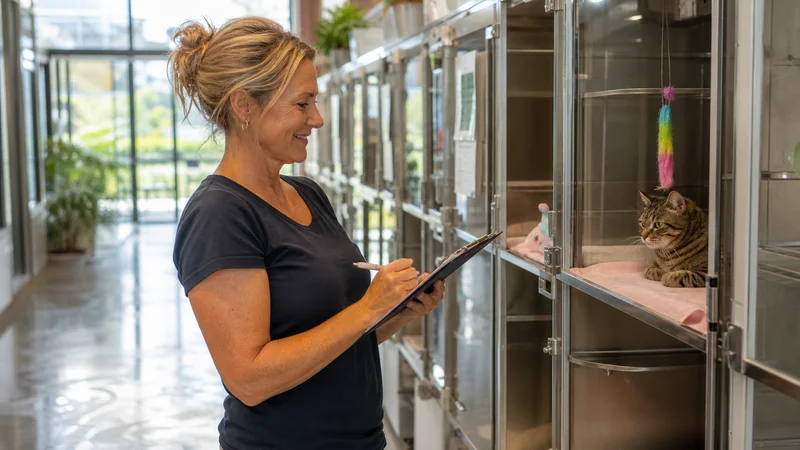
Ask to inspect the relevant areas if the business permits visits. Look for secure gates, clean water, dry sleeping areas and a practical way to separate animals. Avoid treating decorative features as evidence of welfare quality.
Also ask what happens overnight. The answer should explain who monitors the animals, what staff do during an emergency and how the facility contacts owners.
Documents and questions to request before booking
The bottom line is to obtain important details in writing before you pay a deposit or hand over your pet.
A phone conversation can miss key information. Therefore, ask the operator to confirm its requirements by email or provide written terms. Keep the response with your booking documents.
Use this preparation list:
- Current council registration, licence or approval details, where applicable
- Vaccination requirements and accepted evidence
- Feeding, medication and administration instructions
- Emergency veterinary arrangements
- Owner and secondary emergency contact details
- Arrival and collection times
- Isolation or illness procedures
- Transport arrangements, if offered
- Charges for additional medication, grooming or veterinary care
- Refund and cancellation terms
Requirements may differ between operators and jurisdictions, so avoid assuming that one facility’s vaccination policy applies elsewhere. Instead, ask your veterinary practice whether your pet’s records are current and suitable for the facility’s stated requirements.
Before arrival, write down your pet’s normal routine. Include the usual meal times, walking tolerance, hiding places, triggers and signs of distress. A short, accurate handover often helps staff more than a long general description.
Red flags when comparing Australian boarding facilities
The bottom line is that refusal to discuss approval, welfare procedures or emergency care should make you pause.
Some warning signs are easy to miss during a short tour. For example, a facility may look tidy while staff cannot explain who checks animals outside normal business hours. Similarly, a business may advertise “home-style care” without explaining sleeping arrangements or animal separation.
Treat these signs seriously:
- The operator will not discuss council registration or approval.
- Staff refuse reasonable questions about welfare procedures.
- The business cannot explain its emergency veterinary plan.
- You see overcrowding, strong persistent odours or dirty water containers.
- Staff cannot describe how they record medication or feeding instructions.
- The facility pressures you to book without a visit or clear written terms.
- The advertised service differs from what staff show you.
One concern does not automatically prove a breach. However, several unanswered questions suggest that you should compare another provider. If you suspect an animal-welfare issue, seek advice from the relevant local or state authority rather than confronting staff during a stressful incident.
How rules differ across Australia
The bottom line is that there is no single national checklist that replaces local confirmation.
NSW has the specific Animal Welfare Code of Practice No. 5 for dogs and cats in animal boarding establishments. The WA cattery example shows a different type of local requirement involving council or shire registration and possible planning approval. Both sources demonstrate why the phrase boarding kennel Australia rules needs a location attached to it.
Before booking or operating a facility, confirm:
- Which council governs the premises
- Whether the business needs local registration or approval
- Which state or territory department oversees animal welfare
- Whether planning controls apply to the site
- What evidence the operator must provide to customers
Rules and approval processes can change. Therefore, check the current position with the relevant state department and local council in 2026, rather than relying on an old listing, social-media post or another council’s process.
Conclusion: use boarding kennel Australia rules as a checklist
The safest choice is not always the largest or most expensive facility. Look for an operator that can explain its council approval, welfare procedures, cleaning routines, feeding records and emergency veterinary arrangements.
Use the CLEAR check before booking: confirm the council position, inspect the layout, ask about emergencies, provide accurate animal information and read the facility’s rules. For boarding kennel Australia rules, treat NSW requirements as a useful welfare benchmark, but verify the exact position with the relevant local council and state department.
Contact two or three facilities, request the same information from each and compare their answers in writing. If an operator will not show clear approval details or answer basic care questions, keep looking.