Barking Dog Complaint Australia: 7 Steps That Work
Persistent barking can disrupt sleep, work and family life, but the legal test is not simply whether a dog makes noise. The strongest barking dog complaint Australia residents can make identifies unreasonable interference, records when it happens and follows the correct council process for the state or territory.
In Australia, a barking dog may become a nuisance when its ongoing or excessive noise unreasonably interferes with another person's peace, comfort or daily use of their home. Procedures differ between jurisdictions, so document the disturbance, approach the owner safely and contact the relevant local council for guidance.
This guide explains:
- what legally matters;
- how to make a useful complaint; and
- what may happen after you report the problem.
What counts as a nuisance barking dog under Australian law?
The bottom line is that occasional barking usually does not establish a legal nuisance. Authorities generally focus on persistence, excessiveness and the effect on nearby residents, rather than a single noisy incident.
Brisbane City Council explains that some pet noise is normal and reasonable. However, ongoing or excessive barking that disturbs neighbours may qualify as an animal noise nuisance (Brisbane City Council, 2026).
Australian rules are not uniform. A complaint in South Australia follows a different statutory pathway from one in New South Wales, while your local council may manage the practical investigation in either case — much like how dog and cat registration and microchipping rules also vary by state.
In South Australia, section 45A(5) of the Dog and Cat Management Act 1995 makes persistent barking an offence when it unreasonably interferes with another person's peace and comfort. The Legal Services Commission of South Australia identifies a maximum penalty of A$1,250 or a A$315 expiation fee (Legal Services Commission of South Australia, 2026).
Use this distinction when assessing the problem:
| Situation | What it may indicate |
|---|---|
| Short barking after a delivery | Normal pet noise |
| Repeated barking across long periods | Possible nuisance |
| Barking that repeatedly disrupts sleep | Stronger evidence of interference |
| One isolated noisy event | Usually weaker evidence |
Avoid exaggerating the complaint. State what happened, when it happened and how it affected you.
Step one: try to resolve it directly with the owner
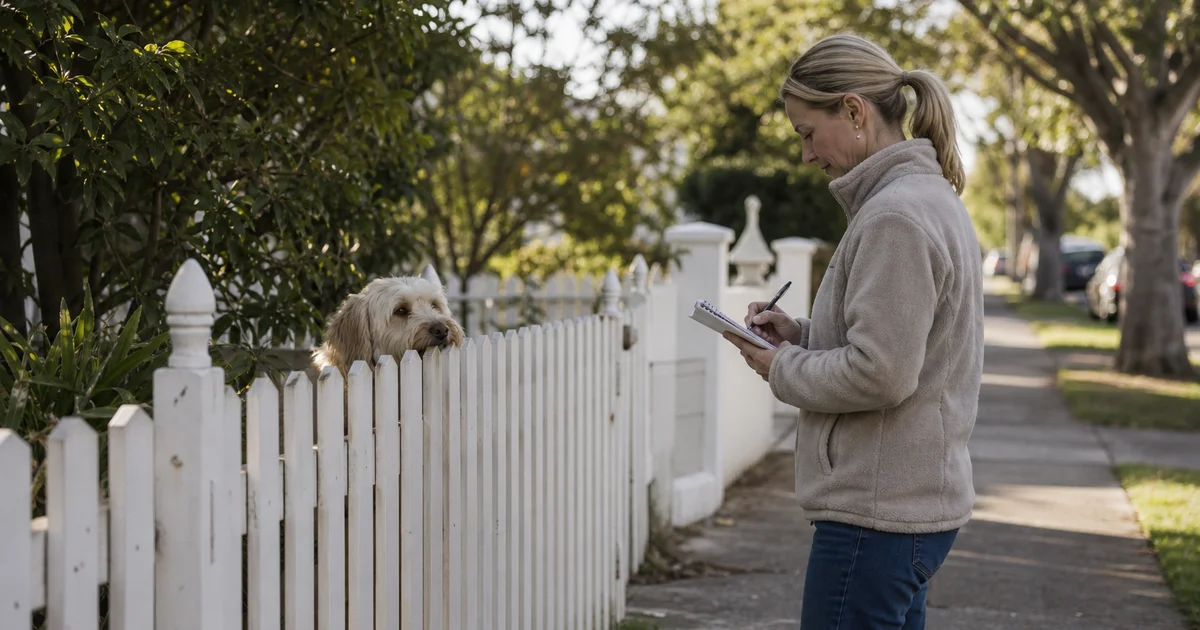
The best first step is usually a calm, safe conversation with the dog's owner. Service NSW says the Office of Local Government suggests speaking with the owner before contacting council about a nuisance complaint (Service NSW, 2026).
The owner may not realise how far the sound travels. They may also believe the barking occurs only briefly. A neutral conversation can produce a faster solution than a formal investigation.
Choose a suitable time, not the middle of a noisy episode. Explain the pattern without labelling the owner or dog. For example, say that barking woke you several times between particular hours, rather than saying the dog is "always unbearable".
You can use this short structure:
- Describe the time and frequency.
- Explain the practical effect.
- Ask whether the owner can investigate the cause.
- Agree on a reasonable way to follow up.
Do not enter the property, confront someone aggressively or place yourself at risk. If the owner becomes threatening, end the discussion and use the appropriate council or emergency channel for the situation.



Pet Health Map App
Turn every worry into your pet’s health record
Download the app to save AI Care reports, build your pet’s medical profile, and keep tracking symptoms and care notes.
Android version coming soon. The web version is available now.
How to lodge a barking dog complaint with your council
A formal barking dog complaint Australia residents submit should contain specific, checkable information. Contact the council where the dog lives and ask for its current animal-noise complaint process. Councils that manage barking complaints are often the same ones that enforce pet ownership limits, so a repeat offender's barking history can sometimes surface during an unrelated council check.
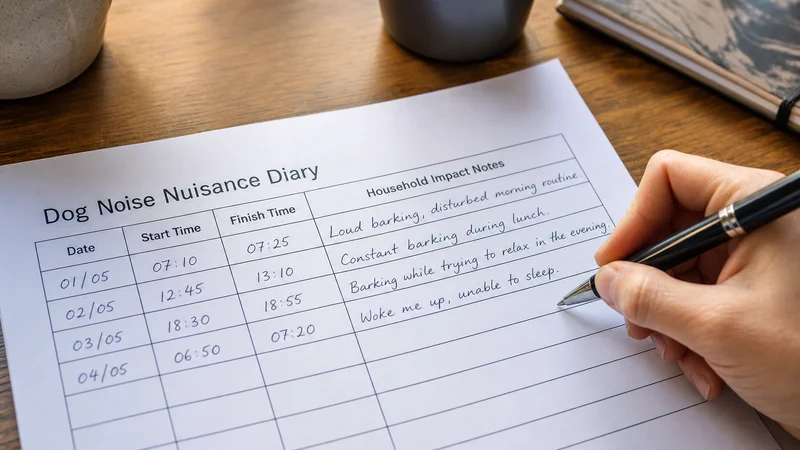
Brisbane City Council's published process asks residents to contact the owner first, then make a formal complaint if the barking continues. Council may also ask the complainant to keep a noise nuisance diary (Brisbane City Council, 2026).
Before contacting council, prepare:
- the property address, if known;
- dates and start and finish times;
- the type of disturbance;
- how often it occurs;
- the effect on sleep, work or normal household activities;
- details of your attempt to contact the owner; and
- any diary, recordings or correspondence you can lawfully provide.
Ask the council officer what evidence it needs. Requirements may include a signed statement, a diary, consent to an officer contacting you or information about other affected residents.
Do not assume an anonymous online comment counts as a formal complaint. Keep the reference number, submission date and name of the department. If you cannot find the process online, call the council and ask specifically for animal noise or nuisance-dog complaints.
What happens after you report: noise diaries and investigations
After a report, council may assess whether the barking is persistent, excessive and unreasonable in context. A noise diary helps officers identify a pattern instead of relying on memory.
Record each event promptly. Include the exact time, approximate duration, sound description and what you were doing. "Barking for 25 minutes while I was trying to sleep" provides more useful information than "barking all night".
A practical CALM record can keep your evidence consistent:
- C — Clock: record start and finish times.
- A — Activity: note what the dog was doing, such as continuous barking or repeated bursts.
- L — Life impact: describe the sleep, work or household disruption.
- M — Message trail: keep dates of conversations and council contacts.
Council may ask for further information or request that you continue recording. Respond promptly and retain copies of everything you send.
Recordings can help demonstrate the character of the noise, but do not trespass, provoke the dog or record private conversations unlawfully. Ask council whether it accepts audio or video material and how it wants files submitted.
Nuisance Dog Orders and Control (Barking Dog) Orders explained
An order is a formal direction requiring the owner to take reasonable steps, and it can carry consequences if ignored. The exact name and process depend on the state or territory — separate to, but sometimes issued alongside, the kind of formal notice used for declared dangerous or restricted dogs.
In South Australia, a local council or the Dog and Cat Management Board can issue a Control (Barking Dog) Order. Under sections 50(6) and 51(e), the order may require reasonable steps to stop the barking and may include a training course (Legal Services Commission of South Australia, 2026).
In New South Wales, section 32B of the Companion Animals Act 1998 sets out the procedure an authorised council officer must follow before issuing a nuisance dog order (NSW Legislation, 2026). That means an order should follow the statutory process, rather than arise automatically from one neighbour's report.
Potential control measures may depend on the order and jurisdiction. They could address supervision, training or steps to reduce the behaviour. The owner should read the document carefully and meet every requirement by the stated time.
For complainants, an order does not guarantee instant silence. Continue recording the disturbance and report non-compliance through the council's nominated channel.
Penalties for owners who ignore an order
Ignoring a formal order can create a separate offence from the original barking problem. However, penalties vary by jurisdiction and should not be assumed across Australia.
In South Australia, breaching a Control (Barking Dog) Order carries a maximum penalty of A$2,500 or a A$500 expiation fee under section 55, according to the Legal Services Commission of South Australia (2026). These are maximum figures, not a promise about the outcome of every matter.
South Australia also treats the original persistent barking offence separately. The owner may face the maximum A$1,250 penalty or A$315 expiation fee identified under section 45A(5).
| South Australian issue | Maximum stated consequence |
|---|---|
| Persistent barking that unreasonably interferes | A$1,250 fine or A$315 expiation fee |
| Breach of a Control (Barking Dog) Order | A$2,500 fine or A$500 expiation fee |
Do not threaten the owner with penalties. Instead, provide council with the order details, dates of continued barking and your updated diary. Council can explain the enforcement route available in your area.
For other states and territories, check the current legislation and council procedure. Do not rely on South Australian amounts elsewhere.
What to do if council will not act
If council does not take the action you expected, ask for a written explanation of the decision and the evidence still required. A refusal to act may mean the information does not yet meet the local threshold, rather than that the barking is acceptable.
Use a measured escalation path:
- Ask which requirement remains outstanding.
- Submit a clearer diary and supporting material.
- Request review by the relevant council team leader.
- Check the council's complaints or internal-review process.
- Obtain independent legal advice if the dispute continues.
Keep communication factual and polite. Include your reference number in every email. Explain the ongoing impact without overstating it.
You can also ask whether another agency has jurisdiction. South Australia is a useful warning: barking complaints are handled by the Dog and Cat Management Board or local council, rather than under the general Local Nuisance and Litter Control Act 2016 (Legal Services Commission of South Australia, 2026).
Do not stop documenting the problem while waiting. A dated record shows whether the frequency changed after the owner or council took action.
Conclusion: build a clear record before escalating
A successful barking dog complaint Australia residents make is specific, proportionate and supported by a consistent record. Start with a safe conversation, then contact the correct local council when the disturbance continues. Use the CALM method to record times, activity, life impact and communications.
Because nuisance-dog laws differ between Australian jurisdictions, check the current council process and avoid applying South Australian penalties to another state. If you receive an order or formal response, follow its instructions carefully and keep copies.
Start your diary today, write down the property details and contact your council's animal-noise team. Those three actions give you a stronger, clearer basis for the next step.