
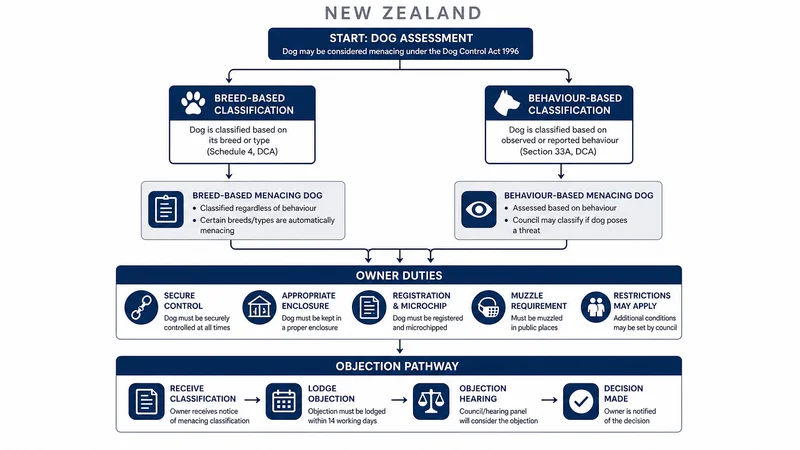
A dog classified as menacing in New Zealand is subject to nationwide legal requirements. The classification may arise from the dog's breed or behaviour. Owners must follow public muzzle and leash rules, arrange microchipping and desexing where required, and understand their objection options before a council deadline passes.
The label can feel confusing, especially when a dog has never harmed anyone. However, New Zealand's Dog Control Act 1996 separates menacing classifications from dangerous classifications. Breed, behaviour, council notices and owner duties can all affect what happens next.
This guide clarifies three practical issues:
- how councils assess and classify a menacing dog NZ residents own or control;
- what muzzle, leash, microchipping and desexing rules apply;
- how menacing and dangerous classifications differ, and what to do after receiving a notice.
Quick answer: menacing dog NZ classifications
The bottom line is that a New Zealand dog can become menacing through its breed or its behaviour. A breed-based classification does not depend on how the individual dog behaves. A behaviour-based classification follows concerns about that dog's conduct. Once classified, the status applies throughout New Zealand.
Breed and behaviour are separate pathways
Auckland Council confirms that a dog may be classified as menacing because of its breed or behaviour. The Dog Control Act automatically classes a dog as menacing when it is mostly or fully one of the specified breeds, regardless of its individual behaviour. (Auckland Council, 2026)
That distinction matters. A calm temperament does not necessarily prevent a breed-based classification. Conversely, a dog outside the specified breed categories may still face classification based on its conduct.
The available sources here do not reproduce the current statutory breed list. Therefore, check the latest wording of the Dog Control Act and your council's written notice rather than relying on an online list or a dog's informal breed description.
The classification follows the dog
Every classification as a menacing dog under sections 33A or 33C remains in force throughout New Zealand. (New Zealand Parliamentary Counsel Office, Dog Control Act 1996)
Therefore, moving from one council area to another does not remove the classification.
Keep the classification notice with your ownership records. Also tell anyone who may take possession of the dog about the relevant public-control requirements.
Menacing dog breed rules: verify the current list
The practical answer is simple: do not guess whether a dog falls within a specified breed category. Confirm the statutory wording and ask the council to explain how it applied the rule to your dog.
Why appearance alone can create uncertainty
Breed identification can become difficult when a dog has unknown parentage, mixed ancestry or incomplete adoption records. A registration description may not answer the legal question. Likewise, a visual guess from a photograph may not settle whether the statutory threshold applies.
Prepare these records before contacting your council:
- adoption, purchase or transfer documents;
- breeder or rescue information;
- vaccination and veterinary records;
- microchip details;
- photographs showing the dog's build and markings;
- any prior council correspondence.
However, avoid presenting an informal opinion as proof. Ask the council to identify the statutory basis for the classification and the information it considered.
Confirm the notice, not just the label
Read the written notice carefully. Look for the classification type, the legal section cited, the date, the council contact and any objection instructions.
The Dog Control Act's nationwide effect means a local dispute can have wider consequences. Therefore, keep copies of every email, form and attachment. If you disagree with a breed-based decision, ask promptly how to make a formal objection or seek professional legal advice.


Pet Health Map App
Turn every worry into your pet’s health record
Download the app to save AI Care reports, build your pet’s medical profile, and keep tracking symptoms and care notes.
Android version coming soon. The web version is available now.
Menacing dog NZ behaviour classifications after an incident
The key point is that behaviour-based classification concerns the council's assessment of the individual dog. Owners should therefore preserve accurate records and respond to the notice, rather than assuming that an absence of injury ends the matter.
Record what happened
Write down the date, location, people present, animals involved and the dog's actions. Separate what you personally saw from what another person reported. Save photographs, messages, veterinary records and witness contact details.
Do not alter the account to make it sound better. A clear, chronological record helps you identify disagreements and answer the council's questions accurately.
Reduce risk while the matter is unresolved
Until the council confirms the dog's status and your obligations, use conservative handling. Keep the dog secured, prevent unsupervised contact and avoid situations that could trigger another complaint.
If the dog has caused an injury or shows sudden aggression, contact a veterinarian promptly. A veterinary assessment may also help you identify pain, illness or environmental stressors. However, medical information does not automatically cancel a council classification.
Ask for the legal basis
A behaviour notice should explain the decision and the owner's next steps. If the explanation is unclear, ask the council which section it relied on and what evidence supports the decision.
This is also the point to check whether the notice contains an objection process. Do not rely on a telephone conversation alone. Follow up important points in writing and keep the council's reply.
Owner duties: muzzling, leashing and desexing
The bottom line is that a classified menacing dog must meet several practical control requirements. The clearest immediate priority is safe public handling, followed by microchipping and the applicable desexing requirement.
Public muzzle and leash rules
A menacing dog must wear a muzzle in public, except when it is inside a vehicle or cage. It must also remain on a leash in public. (Auckland Council, 2026; Rotorua Lakes Council, 2026)
Choose equipment that fits securely and allows safe breathing. Introduce it gradually at home with calm reinforcement. Do not wait until the first public outing to discover that the dog paws at, removes or panics in the muzzle.
The owner must also advise any person taking possession of a dangerous or menacing dog about the requirement to muzzle and leash the dog in public. (New Zealand Parliamentary Counsel Office, Dog Control Act 1996)
Microchipping and desexing
A menacing dog must be microchipped. (Rotorua Lakes Council, 2026) Rotorua Lakes Council also states that the dog must be neutered within one month of classification.
Auckland Council states that a menacing dog must be desexed or certified unfit to be desexed. (Auckland Council, 2026) Because council instructions and veterinary circumstances can affect the process, ask your council and veterinarian to confirm the applicable paperwork and timing.
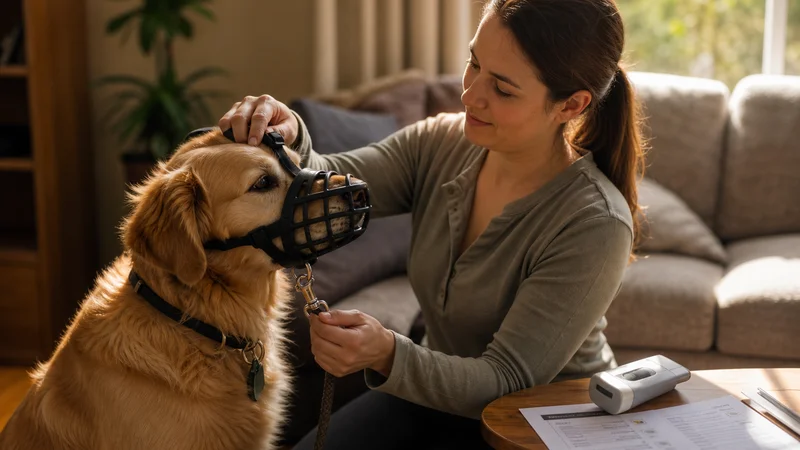
A practical compliance checklist
| Duty | Action to take |
|---|---|
| Muzzle | Fit and practise the muzzle before public outings |
| Leash | Use a secure lead whenever the dog is in public |
| Microchip | Confirm the chip is implanted and records are current |
| Desexing | Contact your veterinarian and council about timing or medical certification |
| Handover | Tell anyone taking possession about muzzle and leash rules |
Dangerous classification: how it differs
The important distinction is that "menacing" and "dangerous" are separate legal classifications. The sources supplied for this article do not provide the complete dangerous-dog test or every dangerous-dog owner duty, so owners should not treat the two labels as interchangeable.
Do not assume one label replaces the other
A menacing classification already creates enforceable control duties. A dangerous classification may involve different requirements and consequences. Therefore, read the exact wording in the council notice instead of relying on a social-media summary or a previous owner's experience.
The Dog Control Act specifically refers to both dangerous and menacing dogs when requiring owners to advise people taking possession about public muzzle and leash requirements. (New Zealand Parliamentary Counsel Office, Dog Control Act 1996)
Confirm requirements directly
Ask the council to confirm:
- the classification recorded against the dog;
- the statutory section used;
- every deadline;
- public-control conditions;
- microchipping and desexing requirements;
- any objection or review pathway.
Fees, local forms and administrative steps can vary. Call ahead and request current written instructions rather than assuming a national rule covers every practical detail.
Objecting to a classification: what to do next
The safest approach is to act quickly, preserve evidence and continue responsible control while the objection is considered. A disagreement does not justify ignoring public-safety requirements.
Build a focused evidence file
Organise the notice, registration records, veterinary documents, photographs and witness statements in date order. Add a one-page timeline that separates facts you observed from information supplied by others.
Also record every council contact. Include the staff member's name, date, advice and any promised follow-up. This makes missing information easier to identify.
Ask about the formal process
The supplied sources confirm that menacing classifications can arise under sections 33A or 33C, and that those classifications operate nationwide. However, they do not provide a complete summary of objection deadlines or hearing procedures.
Consequently, ask the issuing council for the current objection instructions immediately. If the decision could affect where the dog lives, whether it can be transferred or your ability to comply, consider independent legal advice.
Continue compliance during the dispute
Use the muzzle and leash in public, keep the dog secure and ensure other handlers understand the rules. Do not transfer the dog casually. The Act requires an owner to advise a person taking possession of a dangerous or menacing dog about public muzzle and leash requirements. (New Zealand Parliamentary Counsel Office, Dog Control Act 1996)
Conclusion: keep a menacing dog compliant
A menacing dog NZ classification can arise from breed or behaviour, and the status applies throughout New Zealand. Treat the council notice as an active legal instruction: confirm the classification basis, use a muzzle and leash in public, check microchipping, and arrange desexing or veterinary certification within the stated timeframe.
Start a written compliance file today. Contact the issuing council for the current objection process and ask your veterinarian about safe muzzle training and desexing requirements. If you have received a notice, do not wait for another incident before acting.