
Are Shock Collars Legal in Canada? Quebec vs Elsewhere
Many Canadian dog owners want a clear answer before buying an electronic training collar. The legal position changes depending on the province, and animal-welfare rules can apply even where no collar-specific prohibition exists.
Are shock collars legal in Canada? In Quebec, electric or shock collars are prohibited under provincial animal-welfare regulations. Outside Quebec, the supplied legal sources do not establish a nationwide device-specific ban, but Canada’s Criminal Code still prohibits wilfully causing unnecessary pain, suffering or injury to an animal.
This guide explains three practical issues:
- What Quebec’s regulation prohibits.
- Why the position outside Quebec requires careful checking.
- How the Criminal Code affects any training method, regardless of the equipment used.
Quebec’s explicit collar ban
Quebec prohibits several collar types, including electric or shock, choke, prong and martingale collars. The rule applies under the province’s Regulation respecting the safety and welfare of companion animals and equids, enforced by MAPAQ.
The regulation follows a broader welfare principle: a collar must not interfere with an animal’s breathing or cause pain or injury. Therefore, changing the label on a device does not necessarily remove the legal concern. A product marketed as an “electronic”, “remote”, or “training” collar may still function as an electric collar.
LegisQuebec states that first-offence fines can range from C$600 to C$12,000, with higher penalties for repeat offences. Those figures relate to Quebec’s regulation, not to every Canadian province.
The Quebec position can be summarised as follows:
| Collar type | Quebec position under the supplied source |
|---|---|
| Electric or shock collar | Prohibited |
| Choke collar | Prohibited |
| Prong collar | Prohibited |
| Martingale collar | Prohibited |
The safest approach in Quebec is not to buy, import, lend or use one of these collars without obtaining current legal advice. If you already own one, ask MAPAQ or a Quebec veterinary professional about compliant alternatives.

Are shock collars legal in Canada outside Quebec?
Outside Quebec, the available sources do not show one Canada-wide rule that names shock collars specifically. Instead, the legal position can depend on the province, territory, municipal requirements and the facts surrounding use.
That means an owner should not treat “legal to purchase” as the same as “lawful to use”. A collar may be sold openly yet still create risk if its use causes unnecessary pain, suffering or injury. In addition, a local rule may impose requirements that do not appear in a general federal search.
Before buying or using a device, check these points:
- The current animal-welfare legislation for your province or territory.
- Any municipal rules that apply where you live.
- Whether a professional trainer will use the device and under what safeguards.
- The manufacturer’s description of electrical stimulation, vibration and sound functions.
- Whether the collar can be used without an electric setting.
The supplied sources do not verify a province-by-province list of bans. Therefore, this article does not label Ontario or another province as definitively permitting or prohibiting the device. Check the current rule with the relevant provincial authority before relying on a retailer’s claim.


Pet Health Map App
Turn every worry into your pet’s health record
Download the app to save AI Care reports, build your pet’s medical profile, and keep tracking symptoms and care notes.
Android version coming soon. The web version is available now.
Are shock collars legal in Canada under the Criminal Code?
Even where a province has no named collar prohibition, the Criminal Code creates a national animal-cruelty baseline. Section 445.1(1) makes it a federal offence to wilfully cause unnecessary pain, suffering or injury to an animal. It also covers an owner who wilfully permits that harm.
The rule is device-neutral. In other words, it does not need to name a shock collar to matter. Authorities would consider the conduct and its consequences, rather than relying only on the product’s packaging or advertising. If you believe a dog has already been harmed, see our guide on how to report animal cruelty in Canada for who to contact in each province.
The Justice Laws Website states that a summary conviction can carry a fine of up to C$5,000, up to six months’ imprisonment, or both. The Crown may also proceed by indictment. These are federal Criminal Code consequences, not a quoted penalty for using every electronic collar.
This distinction matters:
| Legal question | What the supplied source establishes |
|---|---|
| Is there a national collar-specific ban? | The Criminal Code section is a general cruelty rule, not a device-specific ban |
| Can harmful use still create criminal risk? | Yes, where wilful conduct causes unnecessary pain, suffering or injury |
| Does ownership alone prove an offence? | The source does not establish that; the conduct and harm remain relevant |
Justice Laws Website, Criminal Code of Canada, current text accessed 2026, provides the federal baseline. Therefore, owners should assess the method, not only the equipment.
What to check before buying or using a training collar
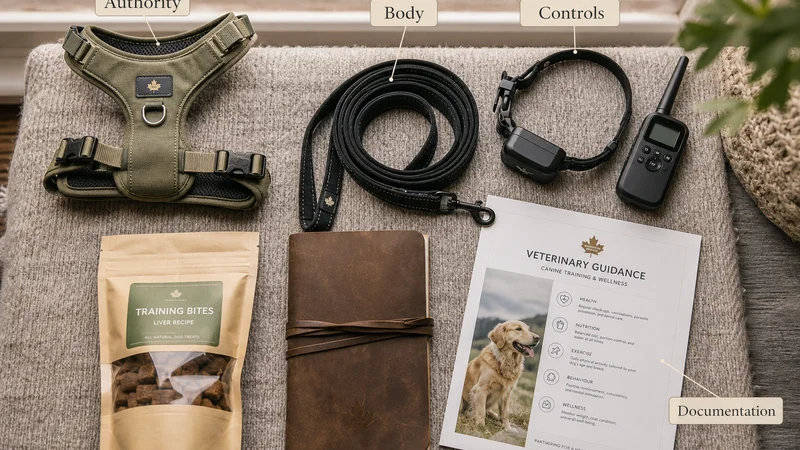
Use the ABCD check before making a decision: Authority, Body, Controls and Documentation. This named check helps prevent a common mistake: focusing on the remote control while overlooking the dog’s welfare and the applicable law.
Authority
Identify the current provincial or territorial authority responsible for animal welfare. Ask whether electric, shock, prong, choke or martingale collars have specific restrictions where you live. Also check local rules rather than relying only on a retailer or online forum.
Body
Inspect the dog’s neck and behaviour before and after any training session. Look for rubbing, swelling, hair loss, coughing, gagging, changes in breathing, fear or avoidance. Stop and seek veterinary advice if you see pain, injury or a sudden behavioural change.
Controls
Read exactly what the product delivers. “Vibration”, “static stimulation” and “tone” can describe different functions. Do not assume a lower setting makes a method lawful or humane. Quebec’s rule focuses on prohibited collar types and the risk of pain, injury or breathing interference.
Documentation
Keep the product instructions, purchase record, trainer’s written advice and notes about the dog’s response. Record the date, setting used, behaviour observed and any physical signs. This information can help a vet assess the dog and helps you explain the situation accurately to an authority.
If the legal position remains unclear, postpone use. A pause costs less than acting on an incorrect assumption.
Safer training choices and a practical next step
When the law or welfare impact is uncertain, choose training that does not depend on pain. Reward-based training can use food, toys, praise, a lead, a harness and careful management of the environment. A qualified veterinary behaviour professional can help when fear, aggression, reactivity or separation problems are involved. If a neighbour's noise complaint is part of the pressure to act quickly, our barking dog complaint guide explains the municipal bylaw process separately. And if the underlying behaviour involves a bite, our dog bite law guide covers the steps that follow an attack.
However, “positive” equipment still needs correct fitting. A harness can rub, a lead can tighten, and poor timing can frustrate a dog. Monitor breathing, skin, movement and behaviour during every session.
Use this short decision checklist:
- Pause if the collar can deliver an electric stimulus.
- Check the current provincial and municipal rules.
- Ask a vet or qualified behaviour professional about the underlying problem.
- Record symptoms, triggers and successful rewards.
- Switch to a non-pain-based plan while you confirm the law.
LegisQuebec, Regulation respecting the safety and welfare of companion animals and equids, current text accessed 2026, confirms Quebec’s explicit restrictions. Justice Laws Website, Criminal Code of Canada, current text accessed 2026, confirms the federal cruelty standard. Together, they show why legal compliance and humane handling must be considered separately.
Conclusion: check your province before using a collar
So, are shock collars legal in Canada? Quebec’s regulation prohibits electric or shock collars, along with choke, prong and martingale collars. Outside Quebec, the supplied sources do not verify a single device-specific rule for every province, but the Criminal Code still prohibits wilfully causing unnecessary pain, suffering or injury.
Before buying or using one, check your current provincial and municipal requirements. Then ask a veterinary professional or qualified behaviour specialist to assess the training problem and recommend a non-pain-based plan. If you live in Quebec, do not use a prohibited collar while seeking advice. Confirm the rule before acting, and keep records of the guidance you receive.